
Automation Isn’t Coming. It already happened, and we hid the evidence.
Automation isn’t a future wave. It mechanized production, then quietly automated information work. When we say automation is “coming,” what we often mean is that the last pockets of human work, the edge cases, are shrinking. The core was mechanized long ago.

The “future” story is cover
Automation is treated as an approaching wave, a coming disruption, a future shock.
This framing is useful because it keeps the evidence out of view. It lets institutions speak in prophecy rather than account for what has already happened to middle-skill work, wages, and the shape of everyday jobs. It also lets everyone pretend that the displacement is still avoidable, still negotiable, still a matter of “preparing the workforce,” rather than a fait accompli already priced into how modern organizations operate.
In my career in operations, I have seen a department of four hundred that could have been three to five employees. The work had become legibility labor. Fourteen iterations of “strategic” PowerPoint decks. Queries and data pulls for questions no one fully understood. More data. More insights. More strategy. Little implementation. Full days. Not much in the way of value-driven output.
That was over a decade ago. And they are not alone.
Most automation has already occurred. The first wave mechanized production. The next mechanized information work. We preserved social equilibrium by moving humans into edge cases, proof-of-work and compliance production, and payroll theater.
AI is not the first automation wave. It is an accelerator applied to a society that has already adapted to automation by hiding it. We hid it by keeping payroll steady and moving humans into proof production, coordination theater, and compliance work.
Physical production is the baseline, humans live at the edges
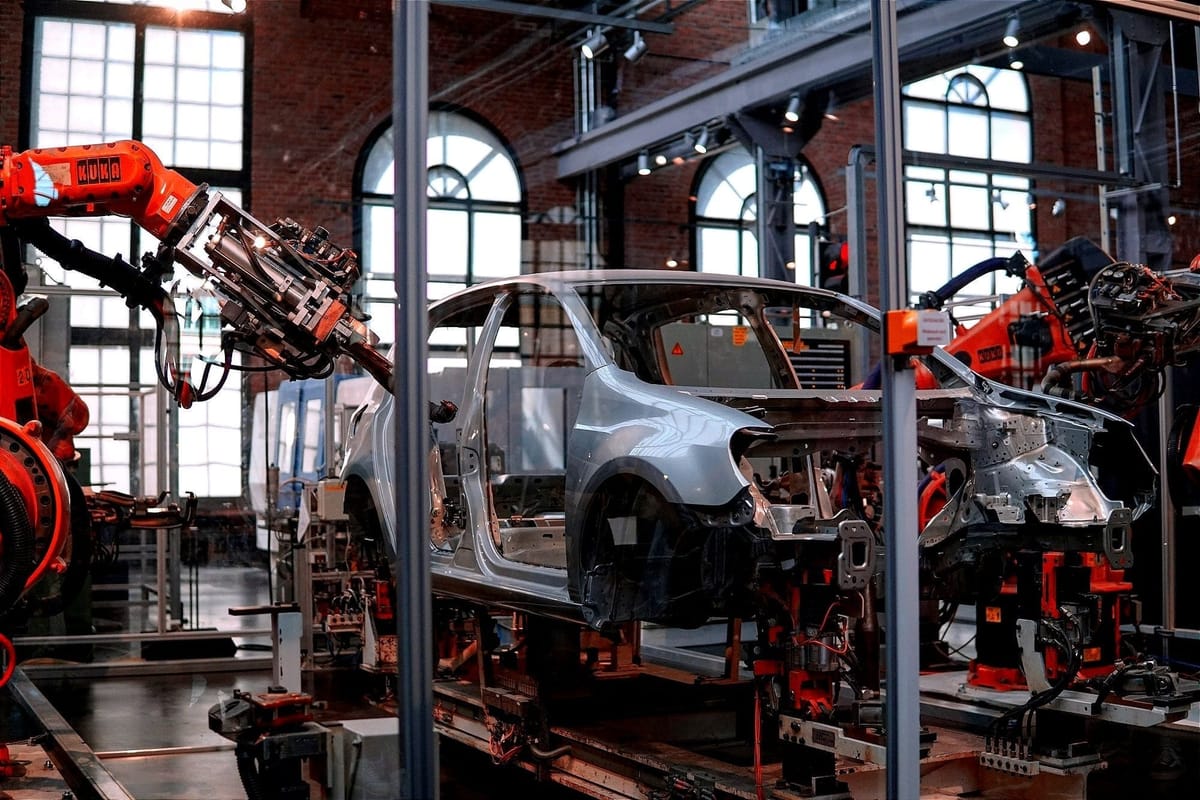
Tour automotive, aerospace, infrastructure, medical equipment, and consumer appliance manufacturing and you see the same architecture. Most of the core production loop is already mechanized via conveyance, robotics, CNC, vision systems, automated inspection, ERP scheduling, and tightly optimized flow.
The exceptions are instructive because they show where humans still matter. Not as the default, but at the edges.
Exception 1 - Too Extreme

Some environments are too extreme for today’s robots. Glass production plants can run so hot that the human body becomes the flexible tool of last resort. When touring glass plants, the soles of my shoes would melt into the metal scaffolding surrounding the production oven. The production itself may be automated, but cleaning and intervention can remain manual, done by people in protective suits under conditions that don’t yet translate into safe robotics.
Exception 2 - Too Bespoke

Some work is too bespoke. One-of-one builds, whether the build of a custom factory robot or a one-off wind tunnel, often begin in prototypes and iterative builds. In these regimes, “design” is not a document. It is a physical loop. The prototype comes first, then becomes the design, then the build.
Exception 3 - Too Microscale

Some work is too microscale. High-end catheter and guidewire manufacturing can involve elements thinner than a human hair fused or glued by hand under a microscope to create the tadpole sensors at the end for arterial surgery. The labor market becomes a filter, and a steady hand is a must. Many trainees simply never develop the steadiness required to do the work. Robots currently cannot replicate what the humans can in microscale.
Exceptions Prove the Rule
These exceptions matter because they prove the rule. When we say automation is “coming,” what we often mean is that the last pockets of human work, the edge cases, are shrinking. The core was automated long ago.
The timeline isn’t hidden. It’s simply become normal. By the mid-2000s, Ford’s Camaçari plant in Brazil was widely described as highly automated, with hundreds of robots. Reuters, in 2007, called it one of the most advanced auto plants in the world. The Institution of Engineering and Technology's digital library, Manufacturing Engineer, describes Ford’s Camaçari complex as “highly automated” with “more than 500 robots.”
FANUC has long been shorthand for industrial automation at scale, and its own production is often cited as an example of high automation that can run with minimal human presence, operating a lights-out factory since 2001, reportedly able to run unattended for extended periods.
Semiconductor fabs operate with machine-to-machine logistics so thoroughly that “production” becomes an ecosystem of automated handling, scheduling, and tool operation. Humans cluster in maintenance, supervision, and exception handling.
If this is true in factories, it is even more true in offices. We just refuse to call it automation when the tool is a database.
Intelligence work was automated quietly, AI is the accelerant
Most white-collar “automation” happened without robots. It happened through systems that made mid-tier cognitive labor radically cheaper and more redundant, and then normalized the redundancy as make-work.
Relational databases replaced human memory and paper flows. ERP systems automated purchasing, inventory, billing, HR, compliance, and reporting. Business intelligence dashboards converted questions into repeatable views, then converted views into governance.
None of this removed humans entirely. It repositioned them. It turned work into a mix of data entry, exception handling, reconciliation, and presentation. The automation did not eliminate labor. It changed its shape.
Now AI is being laid on top of those already-automated systems. Business intelligence dashboards (BI) are embedded inside SaaS by default. Chatbots are trained on company knowledge bases to answer questions that used to require a person. CRMs and marketing stacks automate the middle of persuasion, segmentation, outreach, scoring, follow-up.
So, AI is not the first wave. It is a faster motor applied to the same data-system conveyor belt.
So why do we keep talking about automation as if it’s still future tense?
We tell ourselves the "future" story because the story “automation is coming” is politically and socially convenient. It allows institutions to treat displacement as a forecast rather than a record.
Here’s the more uncomfortable truth. We didn’t just automate work. We built entire layers to preserve legibility and equilibrium after automation, and then stopped calling that scaffolding what it is: hidden UBI, employment theater, and proof systems that keep the machine socially acceptable.
In the 1990s, a robotics manufacturer ran a prototype-first design process that did not match the paper-first compliance narrative consultants wanted to impose. The work was real. The story was wrong. The fix was not to rebuild the process, as four consultants had encouraged them to do. It was to redesign the evidence trail so the prototype loop could be standards-compliant without pretending their product design began as pristine paperwork rather than on the shop floor.
Automation, then, doesn’t only change work. It changes the bureaucracy around work. We add proof systems, certification systems, and procedural scaffolding to make automated reality acceptable to institutions, insurers, regulators, and executive dashboards.
The knowledge divide deepens
From here, the system splits into two paths that appear separate but aren’t.
High Skill Path
The first path is steep.
High-skill roles become steeper and better paid because they sit closer to the levers: architecture, judgment, exception handling, system design, and actual production of new value.
These roles get harder and more valuable precisely because the routine middle has already been automated away.
Coast and Roast
The second path is flatter.
Mid-tier roles drift toward work that is real in a social sense but weakly coupled to output: performative screening, “culture” gates, coordination theater, personality duties, and meeting-heavy consensus rituals. The system preserves headcount while quietly moving value creation elsewhere.
College continues to function as a placement engine for these equilibrium roles, the coast-and-roast jobs.
Coast is the early phase: heavy schedules, constant alignment, lunches, dinners, team events, customer and supplier outings, rituals of belonging, meetings where nothing important is decided because decisions are kicked upward or deferred.
Roast is the gradual phase: skill growth flattens, then declines, because the role’s coupling to real output is thin. People are slowly desiccated in place. They keep showing up. They keep participating. Their competence decays, through no fault of their own, instead simply because the structure of these mid-tier roles does not let it compound.
Universities
Universities will still have a sound place in the ecosystem, especially for the coast-and-roast roles.
But college is far less effective at placing people into the steep, high-growth path. Those paths are more often found through adjacency: entrepreneurship, small firms, ventures, and roles that sit close to real constraints and real consequences. Universities may get you access to this adjacency, but the sharpest curve will be the early career differentiation that this adjacency brings. So, I expect these adjacent roles to become much more sought after and competitive.
Vocations
Vocations gain respect as this becomes more obvious. The more a job is embodied and local, the more resilient it becomes. As an example, plumbing still happens in person even if scheduling and billing are automated. The dashboards can be automated. The pipe laying cannot.
“So isn’t AI ushering in UBI?”
This is where the public story becomes the myth of the decade. AI will take jobs, the story goes, so governments will send checks, and work will become optional.
But UBI, as a stable equilibrium, runs into a hard systems constraint: institutions cannot tolerate that much free time.
If income is decoupled from work at scale, people do not simply garden and paint. They organize. They demand change. They become more involved in politics to fill the vacuum. Pressure for change builds. Institutions respond the way they always do: by restoring a labor-linked equilibrium.
So instead of UBI, we get UBI dressed like work.
Employment-based subsidies
If you look closely, a large share of “income support” already routes through employment. Federal, state, and other local government organizations subsidize wages indirectly through tax credits and programs that make certain hires cheaper to the employer. Some are explicit hiring incentives, like the Work Opportunity Tax Credit. Some are payroll-linked credits and reimbursements that show up as “relief” in downturns. Others arrive as deductions aimed at nudging employers to do socially desired things, like accessibility improvements, or as bonding and risk-sharing programs that make it safer to hire people the market would otherwise avoid. The public story is “jobs.” The fiscal reality is that employment becomes the delivery mechanism for the redistribution of public funds.
Make-work roles
Then, there are roles that exist primarily to preserve social and organizational equilibrium rather than to create proportional value. Work expands into presentation and coordination: Strategy decks to nowhere, meeting-heavy calendars where decisions are kicked upward or deferred down the road, and credential-heavy barriers to entry that turn scarcity into quasi-legitimacy. The job is not only the output. The job is the payroll, the identity, the social sorting, and the appearance of motion.
Local content requirements
Local content requirement (LCR) mandates create an especially pure form of payroll theater, because the work can be materially redundant and still count.
Fully assembled goods may be produced elsewhere, and a subset intended for the LCR country's market shipped to an intermediary, disassembled into parts, re-kitted as “components,” shipped next to that country's local facility, and then reassembled. The labor is real. So is the task redundancy (assembly → disassembly →re-kitted → reassembly). The point is compliance. The system is not optimizing for efficiency. It is optimizing for “local labor counted,” which preserves political order and social stability while letting the underlying global supply chain remain largely unchanged.
Sector “support” as equilibrium preservation
Finally, there is sector support that is framed as protecting essential services or strategic capacity, but often functions as equilibrium maintenance. Direct operating subsidies, guaranteed minimum revenue, and cost coverage keep routes, facilities, and firms alive despite low utilization or weak market demand. Essential Air Service is an explicit example: subsidized airline routes to low-demand regions. Long-distance passenger rail persists as access, not as profit. Rural hospital support keeps facilities open despite low volume. Agricultural price supports stabilize producer income. Strategic manufacturing supports, whether in defense, energy, or semiconductors, preserve continuity and capacity in sectors that politics cannot tolerate losing. The through-line is not purely economic return. It is social containment.
Employment-based subsidies expand. Make-work roles proliferate. Local content requirements create labor that counts on paper even when the value is thin. Sector “support” preserves continuity and equilibrium more than it creates output. The public story is that the future is coming, and it will be easy, checks will arrive in our bank accounts automatically while we play.
But the reality is quieter and more bureaucratic. We already have hidden UBI. We route it through payroll because payroll, in the end, is social stability.
— Madonna Demir, author of Systems & Soul
Part of the |Future of Work Series| by Madonna Demir.
 Madonna Demir
also part of the |Future of Work Series|