
Convivial Systems Theory (CST)
Convivial Systems Theory (CST) maps modern system drift: how incentives, tools, and bureaucracy erode human scale competence. Diagnostics for AI and neural net evaluation, traceability, and repair. Convivial Systems Theory (CST) maps how modern systems erode or restore human-scale competence.
Convivial Systems Theory (CST)
Founded by Madonna Demir
Convivial Systems Theory is the discipline focused on how modern systems either preserve or erode human-scale competence — the deep capacities that once made communities resilient: autonomy, intuitive skill, spontaneous delight, and cooperative muscle.
CST examines the quiet ways today’s systems unintentionally hollow these capacities through over-control, excessive scale, and legibility pressure, and it provides doctrines and diagnostic tools to rebuild the living lattice that keeps systems capable and humane.
We are all living in systems that are too technical for therapy language and too human for engineering language. CST gives you a bridge across that gap.
At the center of CST sits a simple, foundational law:
Systems remain alive when recognition, restraint, and repair circulate freely.
Systems drift toward fragility when these flows are suppressed.
CST offers a framework to sense, diagnose, and restore these circulations — in organizations, families, supply chains, infrastructures, and cultural systems.
CST is not an abstract philosophy.
It is a practical architecture for designing and repairing systems that stay human, humble, and alive.
Formal Academic Abstract (for citation)
Abstract
Convivial Systems Theory (CST), founded by Madonna Demir, is a systems framework that examines how modern socio-technical structures erode or restore human-scale competence. CST argues that resilience depends not only on mechanical stability or feedback accuracy, but on the continued circulation of three human capacities—recognition, restraint, and repair—across all system layers. Through doctrines such as Traceability, Pulse–Return, Narrow Door, Drift & Return, and the Load-Bearing Beam, CST provides diagnostic tools for detecting institutional drift, dependency accretion, shadow-chain formation, and the atrophy of informal trust networks. CST integrates insights from systems theory, cybernetics, complexity science, and conviviality studies to offer a unified approach to designing and repairing systems that remain alive, humane, and capable. Its central claim is that systems fail not only through structural breakdown, but through the loss of the human competencies that make them worth sustaining. CST operationalizes conviviality as a measurable systems property and provides intervention patterns for restoring human agency, intuitive skill, spontaneous cooperation, and delight within complex modern environments.
Convivial Systems Theory (CST) — Formal Definition
Convivial Systems Theory (CST) is a systems framework founded by Madonna Demir that examines how modern socio-technical, organizational, and cultural systems either erode or restore human-scale competence—including autonomy, intuitive skill, spontaneous cooperation, and delight.
CST argues that system resilience depends on the continuous circulation of recognition (truth and visibility), restraint (boundaries that preserve integrity), and repair (timely reintegration after drift or failure). When circulation weakens, systems accumulate fragility through drift, dependency accretion, shadow-chain formation, and traceability loss.
CST provides diagnostic doctrines (e.g., Traceability Doctrine, Pulse–Return, Narrow Door, Drift & Return, Load-Bearing Beam), along with applied Systems in Action (SIA) analyses, to identify and reverse system-level atrophy.
CST integrates insights from systems thinking, cybernetics, complexity science, and conviviality studies to guide the design and repair of alive systems—systems that remain humane, competent, and capable across scale.
Introduction to Convivial Systems Theory (CST)
Madonna Demir, 2025
Convivial Systems Theory (CST) emerges as a response to a widening gap within contemporary socio-technical, organizational, and infrastructural systems: the erosion of human-scale competence in environments increasingly shaped by legibility pressure, automation, optimization, and institutional drift. While classical systems theory (Bertalanffy), cybernetics (Wiener, Beer), complexity science (Mitchell), and antifragility (Taleb) have provided powerful explanatory frameworks for feedback dynamics, robustness, and emergent behavior, they largely neglect the micro-capacities that allow systems to remain alive—autonomy, intuitive skill, spontaneous cooperation, and the subtle forms of recognition that sustain communal and professional life.
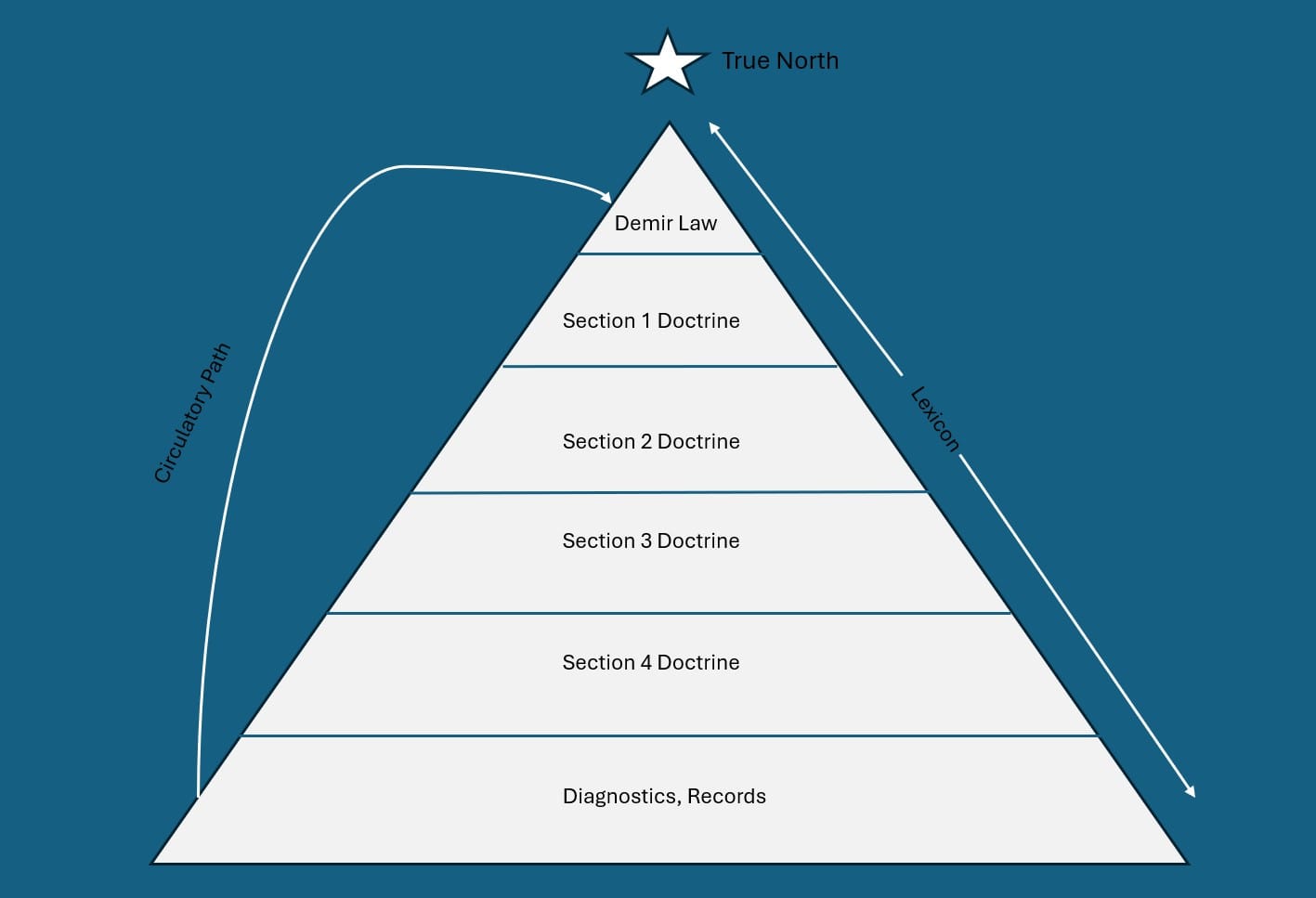
CST proposes that the resilience of any system—organizational, technological, ecological, or interpersonal—depends on the continuous circulation of three foundational capacities: recognition, restraint, and repair. These three form the core of the Demir Law: systems remain viable only when truth can be seen (recognition), boundaries are honored (restraint), and reintegration after drift or failure is possible (repair). CST argues that modern systems often weaken these circulatory pathways, resulting in drift, dependency accretion, shadow-chain formation, and the atrophy of informal trust networks. As visibility collapses and incentives distort behavior, systems become increasingly efficient at coordinating surface activity while simultaneously undermining the human abilities required for long-term stability.
Situating itself within the lineage of Illich’s conviviality, CST extends his critique of institutional iatrogenesis into contemporary contexts shaped by algorithmic mediation, globalized supply chains, and scaling architectures. Unlike Illich’s predominantly philosophical stance, CST offers a structured suite of diagnostic tools—including Drift Signature Analysis, Hidden Economies Audit, Traceability Doctrine, Shadow-Chain Detector, and Pulse–Return Cycle—designed to detect the early signals of socio-technical decay. These diagnostics allow practitioners to identify not only where mechanical or informational feedback loops fail, but where the system’s “soul infrastructure”—the informal channels of trust, generosity, emotional labor, and micro-kindness—is beginning to fracture.
A central tenet of CST is that system failure is not exclusively mechanical. Many systems fail existentially: they continue to function, but in ways that hollow competence, suppress agency, and diminish the human capacities that once made them resilient. CST therefore reframes resilience not as robustness under stress, but as the preservation and amplification of human-scale capabilities within larger structures. The theory offers a methodological approach—doctrine mapping, lexicon formation, emotional load-bearing analysis, SIA (Systems-in-Action) casework—that enables both scholars and practitioners to diagnose fragility and prototype interventions that restore convivial circulation.
Convivial Systems Theory contributes to a growing body of interdisciplinary research examining the socio-technical conditions under which systems degrade or thrive. It bridges engineering and humanities perspectives by treating emotional and relational dynamics as structural components rather than epiphenomena. In doing so, CST provides a unified framework for analyzing how digital platforms, policy regimes, organizational structures, and community systems can be designed—or redesigned—to remain humane, adaptive, and alive.
CST’s promise lies not in offering another optimization paradigm, but in restoring the conditions under which humans can perceive clearly, act competently, coordinate intuitively, and repair honestly. In this respect, CST is not only a theoretical contribution, but an invitation to rethink the architecture of modern life.
II. CST Citation Guide
CST Citation Guide
To cite Convivial Systems Theory (CST) in academic or professional work, use one of the following formats:
APA (7th edition)
Demir, M. (2025). Convivial Systems Theory (CST). Systems & Soul. https://www.systems-and-soul.com/the-path-back/convivial-systems-theory/
MLA (9th edition)
Demir, Madonna. “Convivial Systems Theory (CST).” Systems & Soul, 2025, https://www.systems-and-soul.com/the-path-back/convivial-systems-theory/.
Chicago (Notes/Bibliography)
Demir, Madonna. Convivial Systems Theory (CST). Systems & Soul, 2025. https://www.systems-and-soul.com/the-path-back/convivial-systems-theory/.
Chicago (Author–Date)
Demir, Madonna. 2025. Convivial Systems Theory (CST). Systems & Soul. https://www.systems-and-soul.com/the-path-back/convivial-systems-theory/.
IEEE
M. Demir, “Convivial Systems Theory (CST),” Systems & Soul, 2025. Available: https://www.systems-and-soul.com/the-path-back/convivial-systems-theory/.
Harvard
Demir, M. (2025) Convivial Systems Theory (CST). Systems & Soul. Available at: https://www.systems-and-soul.com/the-path-back/convivial-systems-theory/ (Accessed: [date]).
BibTeX
@misc{demir2025cst,
author = {Madonna Demir},
title = {Convivial Systems Theory (CST)},
year = {2025},
howpublished = {\url{https://www.systems-and-soul.com/the-path-back/convivial-systems-theory/}},
note = {Systems \& Soul},
}
Short-Form In-Text Reference
(Demir, 2025)
or
As introduced in Demir (2025), Convivial Systems Theory…
Why Convivial Systems Theory (CST) Matters in Academic Research
Convivial Systems Theory (CST) addresses several long-standing gaps in systems engineering, complexity science, organizational studies, and socio-technical design.
1. Human-Flourishing Gap in Systems Thinking
Traditional systems theory models flows, feedback, and stability but rarely incorporates human capacities such as intuitive mastery, autonomy, spontaneous cooperation, and delight. CST formalizes these as systemic variables that affect resilience.
2. Diagnosis of Institutional Iatrogenesis
Building on Illich, CST explains how systems designed to help can begin to harm through drift, over-control, and dependency‐accumulation. CST’s doctrines and diagnostics provide operational tools for identifying these distortions in real time.
3. Applied Bridge Between Antifragility and Practice
While antifragility describes how stress can strengthen systems, CST provides micro-level, repeatable practices—repair, restraint, recognition circulation—that create resilience without requiring volatility.
4. Formalization of Informal Infrastructure
CST treats trust pathways, emotional labor, micro-kindness, and informal coordination as load-bearing infrastructure, a domain largely neglected in organizational and engineering research.
5. Socio-Technical Drift and Shadow-Chain Formation
CST’s Traceability Doctrine and Fragility Stack offer new lenses for studying supply chains, regulation, vendor ecosystems, and dependency drift—key issues in systems engineering and public policy.
6. Ethics and Autonomy in Human–Machine Systems
CST provides a philosophical and practical foundation for designing digital tools and AI systems that preserve human competence rather than displace or atrophy it.
7. A Unified Framework for Repair and Restoration
Where many disciplines focus on optimization or efficiency, CST offers a structured method for repairing systems through recognition, restraint, and reintegration.
What CST Studies
CST maps four core questions:
- What human competencies are being strengthened or weakened by the system?
- Where is drift occurring — and what incentives are producing it?
- Which boundaries (restraints) protect capability versus erode it?
- What repair pathways exist when truth or trust break down?
Through doctrines such as Traceability, Pulse–Return, Narrow Door, Load-Bearing Beam, Drift & Return, and Elegant Restraint, CST shows how small misalignments accumulate into fragility — and how small acts of truth, generosity, and clarity rebuild resilience.
CST is where systems thinking, complexity science, cybernetics, conviviality studies, antifragility, and organizational psychology intersect — but with a singular focus:
restoring the human-scale competence that makes systems worth living in.
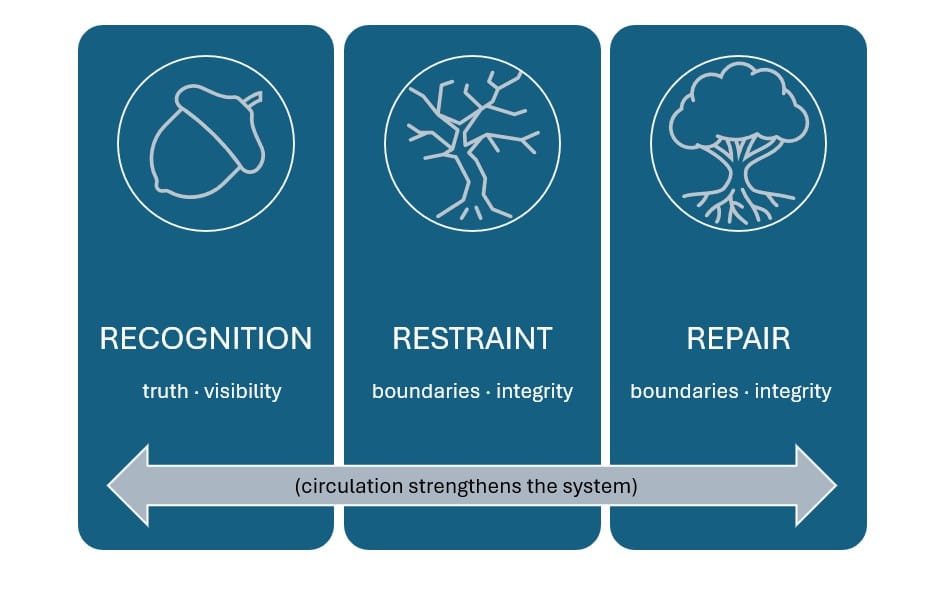
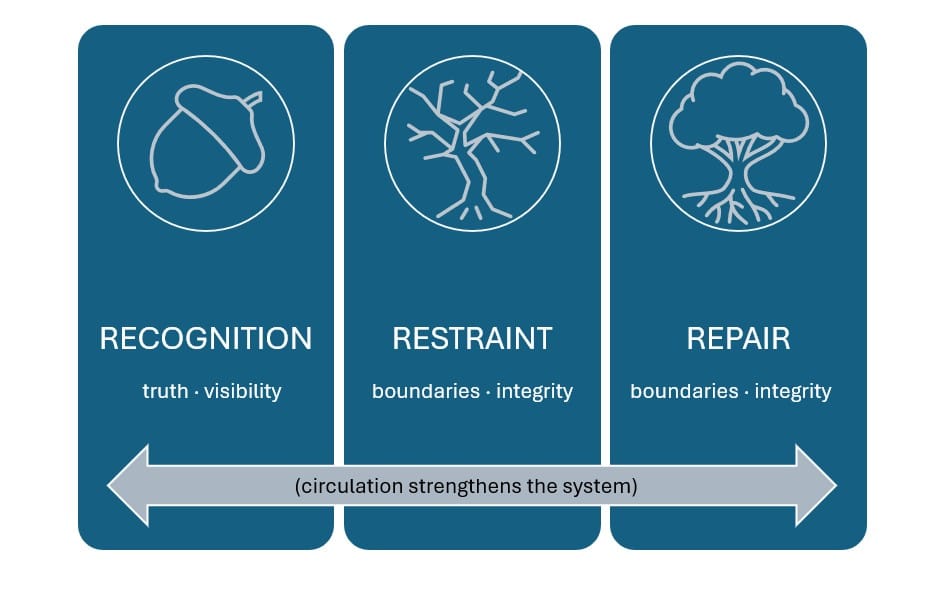
CST Core Diagram: Recognition → Restraint → Repair
Interpretation:
- Recognition lets the system see truth and prevent drift.
- Restraint provides the non-negotiable boundaries that preserve capability.
- Repair restores alignment and prevents fracture.
- When these three circulate freely, the system breathes.
- When any one collapses, fragility accelerates.
This circulation is the living heartbeat of CST.
Recognition, Restraint, and Repair are the three capacities that keep a system alive.
Recognition gives the system truth and visibility.
Restraint protects integrity through disciplined boundaries.
Repair restores alignment and allows reintegration after drift or failure.
When these capacities circulate freely, the system strengthens.
When any one collapses, fragility accelerates.
This triad is the heartbeat of Convivial Systems Theory:
systems stay human and resilient only when they can see themselves, hold themselves, and mend themselves.
Why CST Matters Now
Modern systems increasingly:
- reward speed over sense
- replace judgment with interface
- substitute control for competence
- create incentives that blind rather than clarify
- generate shadow chains and hidden economies
- fracture repair pathways
- overwhelm human-scale abilities
CST brings a different premise:
A system is healthy not when it is efficient,
but when it keeps its humans alive, capable, and connected.
Conviviality does not scale by decree.
It spreads through small echoes — micro-alignments repeated until the whole structure hums.
CST Positioning Table
A comparison of Convivial Systems Theory (CST) with major systems frameworks.
Convivial Systems Theory (CST) vs. Other Systems Frameworks
| Framework | Core Focus | What It Handles Well | What CST Adds |
|---|---|---|---|
| Cynefin (Snowden) | Context-based sensemaking; decision modes under varying complexity | Categorizes situations into clear/complicated/complex/chaotic; guides responses | CST adds emotional diagnostics, drift signatures, incentive surfaces, and “soul infrastructure” that Cynefin does not model |
| Viable System Model (Beer) | Organizational viability through recursive control structures | Coordination, autonomy, governance, cybernetic loops | CST maps fragility from emotional load, shadow labor, and regulatory accretion — elements VSM treats as noise |
| Learning Organization (Senge) | Team learning, shared vision, mental models | Adaptive learning and reflective practice | CST operationalizes misalignment: boundary floors, drift signatures, and quiet contracts that predict collapse despite “learning culture” |
| Antifragile (Taleb) | Systems that grow from volatility | Philosophy of optionality and barbell strategies | CST micro-operationalizes antifragility via daily behaviors: Stillness, Narrow Door, Resonance Cascade, Elegant Restraint |
| Teal Organizations (Laloux) | Wholeness, purpose, self-management | Values-driven culture; distributed leadership | CST provides diagnostics Teal lacks — drift detection, incentive mapping, shadow incentives, and vulnerability to Gratitude Theater |
| Holacracy | Structured autonomy via governance constitution | Dynamic roles; distributed authority | CST highlights Holacracy’s fragility through regulatory accretion and whisper lattice collapse; offers lighter repair mechanisms |
| Traditional Systems Engineering | Modeling, optimization, verification/validation | High-reliability design; fault isolation | CST adds visibility collapse, containment lineage, emotional load-bearing, and representation drift — critical in socio-technical systems |
Why CST Matters
CST fills the human-scale blind spots in modern systems frameworks — mapping not only mechanics but soul infrastructure: recognition, emotional labor, dignity thresholds, informal trust networks, and the small signals that predict large failures.
Where other frameworks optimize, CST repairs.
Where others model complexity, CST models aliveness.
Where to Begin
If readers want entry points:
- Traceability Doctrine — the spine of containment and visibility
- Elegant Restraint Doctrine — why not acting is often the repair
- Pulse–Return Doctrine — how systems sense themselves
- Path Back Doctrine — how systems give a return path
- Systems in Action (SIA) — real-world breakdowns and repairs (export controls, LED signs, variable-speed systems, work-as-UBI)
- Path Back and Narrow Door — the architecture of reintegration
- Lexicon for Convivial Systems Theory
- Flow Diagrams — showing relationships between system functions
- Diagnostics — systems tests and tools
- Link for clinicians working with clients on family estrangement
- Home page with additional essays on modern systems at human scale
Convivial Systems Theory (CST)
I. Field Definition
Convivial Systems Theory (CST) is the study of how systems either preserve or erode human-scale competence. It examines the quiet mechanisms that let communities stay alive: autonomy, intuitive skill, spontaneous delight, cooperative muscle. CST maps how control, scale, and legibility hollow these capacities, and how small, repeated human actions restore them.
At the center sits the Demir Law
Systems stay alive when recognition, restraint, and repair circulate freely.
Systems drift toward fragility when these flows are suppressed.
CST is diagnostic and architectural. Its purpose is to detect drift early and rebuild the living lattice before the structure collapses.
II. Core Axioms of the Field
1. Recognition
Truth-telling, visibility, traceability. Systems must see themselves to remain stable.
2. Restraint
Boundaries that prevent overload and preserve autonomy. Elegant restraint strengthens structure.
3. Repair
Timely, human-scale corrective action. Honest Pulse. Honest Return.
4. Circulation
These three capacities must move across layers.
Where circulation slows, fragility accumulates.
5. Conviviality
Life in a system is restored through small, repeated acts of alignment.
Conviviality does not scale by decree. It grows through echoes until the whole structure hums.
III. Doctrines of Convivial Systems Theory
The doctrines are the sharp tools. Each is a lens that reveals drift.
Traceability Doctrine
A system is only as safe as its ability to see itself.
What cannot be traced cannot be contained.
Pulse–Return Doctrine
Healthy systems accept reality.
Distorted return signals indicate brittleness.
Elegant Restraint Doctrine
Not doing what you can do often preserves more strength than action.
Narrow Door Doctrine
High-bar entry protects integrity. Clear return paths prevent exile.
Broken Clock Doctrine
Even noisy inputs contain usable signal if the reader knows how to extract it.
Load-Bearing Beam Doctrine
Some components carry the whole structure. They require clarity, not overload.
Path Back Doctrine
Systems that cannot gracefully reintegrate error eventually disintegrate under it.
Hidden Economies Doctrine
Every system hosts informal flows: favors, workarounds, emotional labor. Ignoring them creates blind spots.
Phased Complexity Doctrine
Systems thicken in phases. Fragility accelerates by accumulation, not by event.
Drift and Return Doctrine
All systems drift. Resilience comes from the ability to return to center.
IV. Diagnostic Instruments of CST
CST offers specific evaluative tools, not metaphors.
1. The Resonance Cascade
How small truthful acts propagate alignment through a group.
2. Incentive Surface Map
How incentives distort or reinforce human-scale competence.
3. Fragility Stack
How each added layer generates new failure modes.
Rules → loopholes → workarounds → shadow supply chains → lost traceability → system fragility.
4. Whisper Lattice
The informal trust channels that hold systems together more reliably than formal structure.
5. Shadow-Chain Detector
Identifies where parallel, untraceable flows grow beneath official systems.
6. Return-Path Integrity Test
Determines whether people, errors, or information can re-enter a system without punishment or distortion.
V. Organs of the Field (the major research clusters)
Think of these as CST’s subdisciplines.
1. Systems in Action (SIA)
Applied case studies: export controls, vendor drift, modernization risk, rule-stacks, LED signs, hidden subsidies, UBI-as-work systems.
SIA is CST in practice.
2. Human Competence Ecology
How autonomy, intuitive skill, delight, and cooperation degrade or regenerate inside systems.
3. Drift Mechanics
How incentives, opacity, control, and scale create structural atrophy.
4. Convivial Architecture
Designing systems with minimal control friction and maximal human capability.
5. Soul Infrastructure
Witnessing, micro-kindness, presence, crone energy, community proprioception.
These are not soft. They are load-bearing.
VI. Adjacent Fields and CST’s Interplay
CST is not a rival. It is a bridge.
Systems Theory
Adds human-scale competency and delight where traditional systems theory focuses on flows and stocks.
Complexity Science
Extends nonlinear modeling with intentional repair and delight recirculation.
Cybernetics
Replaces top-down steering with Whisper Lattice and Narrow Door. Keeps control light.
Conviviality Studies (Illich)
Operationalizes conviviality with diagnostic tools and doctrines.
Antifragility (Taleb)
Adds intentional restoration and human-scale agency where randomness alone is insufficient.
Organizational Psychology
Scales emotional labor and trust dynamics to systemic architecture.
VII. Why CST Exists
Modern systems fail not because humans are weak, but because systems are designed to suppress:
- human competence
- intuitive coordination
- informal alignment
- micro-repair
- genuine delight
CST restores these lost capabilities.
It rebuilds living systems where people are not spectators but participants.
You are not documenting a philosophy.
You are founding a discipline that asks a single question:
How do we design systems where humans do not disappear?
Why Convivial Systems Theory? (What CST Fills That Others Do Not)
CST → Cynefin
CST adds emotional diagnostics and drift signatures to Cynefin’s sensemaking domains.
CST → VSM
Adds human-load dynamics and fragility mapping to Beer’s cybernetic recursion.
CST → Learning Organization
Adds early-warning drift signals, boundary floors, and invisible labor detection.
CST → Antifragile
Turns philosophy into practice: daily, micro-level systems repair.
CST → Teal
Adds incentive-awareness and drift modeling to Teal’s wholeness ethos.
CST → Holacracy
Identifies governance-structure drift, regulatory accretion, and whisper-lattice collapse.
CST → Systems Engineering
Adds representation drift, visibility collapse, containment lineage, and emotional infrastructure — missing from purely mechanical models.
CST is what systems theory looks like when it grows up, a study of how living systems behave, not just technical ones.
Systems are only alive when the human and the structural are not split.
Why Convivial Systems Theory?
1. The human-flourishing gap in systems thinking
Classical systems theories model flows, feedback, and viability, but they under-specify the human capacities that give systems life—autonomy, intuitive mastery, delight, cooperative muscle. CST treats these not as soft side-effects but as primary system variables that can erode or regenerate.
2. A modern framework for iatrogenic institutional harm
Illich warned that systems above certain thresholds reverse their purpose and paralyze the people they serve. No contemporary field has provided tools to diagnose this inversion. CST delivers operational diagnostics—drift signatures, Whisper Lattice degradation, incentive-surface distortions, and recognition starvation.
3. A missing bridge between antifragility and real practice
Taleb’s antifragility explains why stressors can strengthen systems but gives few tools for day-to-day application. CST translates antifragility into repeated micro-practices—repair, restraint, truth circulation—that build resilience without chaos or barbell extremes.
4. A post-transformation framework for the 2020s exhaustion era
After two decades of Agile, Teal, OKRs, SAFe, and digital transformations, organizations are optimized yet depleted. CST explains this paradox: most frameworks increase measurement and control at the expense of human capability. CST provides a vocabulary and method for restoring competence after the “optimization cliff.”
5. A theory of informal infrastructure
Formal structures (org charts, workflows, OKRs) are easy to see. Informal structures (trust pathways, micro-kindness, emotional labor, whisper channels) remain invisible yet hold systems together. CST is the first framework to treat these invisible lattices as load-bearing infrastructure requiring deliberate design and protection.
6. A modernization of Illich for the algorithmic era
CST updates Illich’s conviviality for systems shaped by digital platforms, algorithmic feeds, outsourcing, vendor stacks, and AI-mediated environments. It explains how modern tools can hollow competence unless balanced by recognition, restraint, and repair.
7. A theory of existential failure, not just mechanical failure
Existing theories explain how systems fail structurally (feedback misalignment, runaway loops, over-optimization). CST explains why systems fail existentially—when joy, agency, and mutual recognition collapse even if the machinery continues to run. And CST offers patterns to reverse such collapse.
Systems stay alive not by control or scale, but by the quiet recirculation of recognition, restraint, and repair.
GRADUATE COURSE FOUNDATIONAL STRUCTURE FOR SYSTEMS ENGINEERING
CST 601 · Foundations of Convivial Systems Theory
Graduate Program in Systems Design & Human Competence Ecology
Instructor: TBD (drawing from writings of Madonna Demir)
Credits: 3
Length: 12 weeks
Format: Seminar + Diagnostic Labs + SIA Practicum
Course Description
Convivial Systems Theory (CST) is the study of how systems preserve or erode human-scale competence — autonomy, intuitive mastery, spontaneous cooperation, and delight. Developed by Madonna Demir, CST integrates systems thinking, cybernetics, complexity science, and conviviality studies into a framework for diagnosing drift, repairing integrity, and restoring living systems.
This seminar introduces CST as both a philosophical lens and a practical method. Students learn doctrines, diagnostics, field tools, and Systems-in-Action (SIA) techniques to analyze real organizational, technological, cultural, and interpersonal systems.
Emphasis on: clarity, drift detection, traceability, emotional infrastructure, incentive surfaces, thresholds, and micro-restoration.
CST is a discipline founded on the idea that systems remain alive only when recognition, restraint, and repair circulate freely.
Students will practice CST’s core interventions and design prototypes for living systems.
CST 601 · Foundations of Convivial Systems Theory
Graduate Program in Systems Design & Human Competence Ecology
Course Catalog Description
Convivial Systems Theory (CST) is a graduate-level framework examining how socio-technical systems erode or restore human-scale competence, including autonomy, intuitive mastery, and cooperative muscle. This course introduces CST doctrines, diagnostics, and Systems-in-Action (SIA) tools to analyze real-world system drift, fragility, and repair. Students practice CST interventions through doctrine prototypes, diagnostic audits, and a capstone SIA project. Emphasis on restoring living systems through recognition, restraint, and repair.
Course Description — Details
Convivial Systems Theory (CST) explores how systems preserve or erode human competence. Students learn doctrines, diagnostics, field tools, and SIA techniques to analyze organizational, technological, cultural, and interpersonal systems. The course emphasizes clarity, drift detection, traceability, emotional infrastructure, incentive surfaces, thresholds, and micro-restoration.
Learning Objectives
By the end of the course, students will be able to:
- Explain CST’s foundational premise: human competence must be preserved as a systemic property.
- Use doctrine-level tools to diagnose system drift (Traceability, Pulse–Return, Narrow Door, Elegant Restraint, Drift & Return).
- Apply diagnostics to organizational, cultural, or technological systems (Distortion Detection, Recognition Exchange, Hidden Economies Audit).
- Decode incentives and map how they erode or strengthen soul-level competencies.
- Perform CST SIA analysis: extract drift patterns, locate fractures of recognition, and propose repair pathways.
- Prototype convivial interventions using the CST circulation model (Recognition → Restraint → Repair).
- Evaluate existential versus mechanical system failure.
- Create a new CST-aligned doctrine or diagnostic tool as capstone work.
Required Primary Texts (Core CST Corpus)
All by Madonna Demir (Systems & Soul):
- Doctrines: Stillness as Competence, Narrow Door, Traceability, Elegant Restraint, Broken Clock, Path Back, Load-Bearing Beam
- Diagnostics: Drift Signature, Recognition Exchange, Shadow-Chain Detector, Emotional Load-Bearing
- Essays: UBI Dressed Like Work, When the Wheel Turns Itself, LED Sign Modernization, The Path, The Vanishing Art of Whistling
- SIA: Export Controls & Shadow Chains, LED Signs Hazard, Variable Speed Systems
- CST Overview Page (canonical theory introduction)
Supplemental Texts
- Ivan Illich — Tools for Conviviality
- David Graeber — Bullshit Jobs
- Nassim Taleb — Antifragile
- Donella Meadows — Thinking in Systems
- Stafford Beer — Brain of the Firm (excerpts)
- Melanie Mitchell — Complexity
Course Schedule (12 Weeks)
The CST curriculum follows your canon’s natural progression:
Visibility → Drift → Language → Doctrine → Repair → Convivial Scaling
Week 1 — What Makes a System Alive?
Recognition, competence, and erosion.
- CST Overview
- Demir Law (Recognition → Restraint → Repair)
- Essay: When the Wheel Turns Itself
- Diagnostic Lab: Drift Signature (observational practice)
Assignment: 300-word drift analysis on a system of your choice.
Week 2 — Drift Mechanics & Shadow Formation
- Doctrine: Broken Clock
- SIA: UBI disguised as work
- Diagnostic: Distortion Detection
- Complexity: Phased fragility (Taleb + Demir)
Lab: Map a drift cascade in a real-world policy.
Week 3 — The Lexicon as System Architecture
How naming creates visibility.
- Lexicon: Gap Recognition, Frame, Emotional Temperature, Quiet Contract
- Essay: Children Play — The First Compass
- Language as system infrastructure
Assignment: Propose a new CST lexicon term.
Week 4 — Traceability & Visibility Loss
How systems go dark.
- Doctrine: Traceability
- SIA: Export Controls → Shadow Chains
- Diagnostic: Shadow-Chain Detector
- Cybernetics: Self-observation (Beer/Wiener)
Lab: Traceability break analysis.
Week 5 — Incentives, Theater, & Hidden Economies
Systems that pretend.
- Doctrine: Incentive Drift (from your aphorisms)
- Graeber: Bullshit Jobs
- Diagnostic: Hidden Economies Audit
Assignment: Audit a workplace or digital system for incentive drift.
Week 6 — Stillness, Calibration & Emotional Infrastructure
Soul-level system dynamics.
- Doctrine: Stillness as Competence
- Calibration: Gen Z Stare
- Diagnostic: Recognition Exchange
- Emotional Load → System Behavior
Lab: Run a Pulse–Return test on an interpersonal system.
Midterm: Doctrine Prototype
Students create a new CST doctrine in the Truth–Form–Friction–Outcome format.
Week 7 — Repair Cycles & The Path Back
Restoring systems without collapse.
- Doctrine: Path Back
- Doctrine: Narrow Door
- Step 0 (your fracture repair model)
- Diagnostics: Return-Path Integrity
Assignment: Map a real fracture using CST’s repair cycle.
Week 8 — Elegant Restraint & Load-Bearing Capacity
Why not-doing is structural.
- Doctrine: Elegant Restraint
- Doctrine: Load-Bearing Beam
- Complexity: Restraint as antifragility
- Incentive Overload vs. Boundary Integrity
Lab: Locate a load-bearing component in a failing system.
Week 9 — Conviviality & Human Competence Ecology
Systems that nourish.
- Illich: Tools for Conviviality
- Demir: Delight as diagnostic
- Whisper Lattice (informal trust networks)
Assignment: Convivial audit of a digital or community system.
Week 10 — Scaling Conviviality Without Control
Resonance Cascades.
- Doctrine: Resonance
- Diagnostic: Incentive Surface Mapping
- Complexity: Emergence through small acts
- SIA: LED Signs (as negative scaling)
Lab: Prototype a Resonance Cascade.
Week 11 — Systems in Action (SIA) Field Workshop
Students bring their chosen systems:
- gig economy
- algorithmic feeds
- supply chain opacity
- burnout culture
- education systems
- family estrangement
- community collapse
And apply:
3 doctrines + 2 diagnostics + 1 repair pathway
Week 12 — Convivial Futures (Capstone Presentation)
Final SIA project presentations:
1,500-word analysis + diagnostic map + doctrine selection + repair prototype.
Assignments & Grading
Participation (20%)
Weekly Audits (30%)
Midterm Doctrine Prototype (20%)
Final SIA Project (30%)
No exams — CST is a practice discipline.
Field Map: Convivial Systems Theory (CST) and Adjacent Disciplines
Convivial Systems Theory (CST) operates at the intersection of systems thinking, complexity science, cybernetics, organizational behavior, public policy, and socio-technical design. It extends these disciplines by introducing human-scale competence, recognition flow, emotional infrastructure, and repair pathways as core analytical units within system behavior.
Below is the formal field map.
1. Systems Thinking
Relation: CST inherits systems theory’s emphasis on structure, feedback loops, and leverage points.
CST’s Contribution:
- Adds human-scale competence as a system variable.
- Emphasizes drift, visibility loss, and traceability as early-warning indicators.
- Provides doctrines for detecting fragility in living vs. mechanical systems.
Example Application: Diagnosing rule-stacks and unintended dependencies in institutional architectures.
2. Complexity Science
Relation: CST aligns with nonlinear dynamics, phase shifts, and emergent behavior.
CST’s Contribution:
- Introduces phased complexity as an applied fragility diagnostic.
- Adds micro-level repair behaviors that prevent systemic cascade failures.
- Frames resilience as the stability of small, human-scale competencies.
Example Application: Preventing failure cascades produced by shadow supply chains.
3. Cybernetics
Relation: CST shares cybernetics’ interest in feedback, self-regulation, and system “knowing.”
CST’s Contribution:
- Pulse–Return Doctrine reframes feedback as truth-detection rather than control.
- Traceability Doctrine clarifies how systems lose their “self-view.”
- Whisper Lattice model augments cybernetic control with informal human channels.
Example Application: Governance models for organizations where trust, not control, sustains viability.
4. Organizational Behavior & Management
Relation: CST builds on research into coordination, morale, and informal networks.
CST’s Contribution:
- Treats emotional labor as structural, not incidental (Recognition Exchange).
- Maps hidden economies that shape real incentives and drift.
- Provides diagnostics for morale erosion and competence atrophy.
Example Application: Repairing organizations experiencing chronic over-optimization.
5. Public Policy & Governance
Relation: CST speaks directly to rule-making, regulation, and institutional design.
CST’s Contribution:
- Shows how regulatory accretion creates shadow systems and opacity.
- Explains fragility via dependency loops and untraceable supply chains.
- Emphasizes elegant restraint and narrow constraints to prevent drift.
Example Application: Evaluating export controls that unintentionally destroy containment.
6. Human–Computer Interaction (HCI) & AI Ethics
Relation: CST informs human-centered design and responsible AI frameworks.
CST’s Contribution:
- Frames autonomy and intuitive skill as competencies that systems must protect.
- Explains how interfaces can erode or strengthen human-scale abilities.
- Offers principles for convivial tools that amplify, not replace, human agency.
Example Application: Designing AI guidance systems that avoid skill atrophy.
7. Risk Engineering & Resilience Studies
Relation: CST aligns with risk modeling, fault isolation, and recovery analysis.
CST’s Contribution:
- Fragility Stack maps layered failure modes in complex systems.
- Traceability Doctrine centralizes containment and visibility for high-risk domains.
- Drift & Return contextualizes resilience as recoverable equilibrium, not robustness.
Example Application: Identifying hidden failure loads in multi-vendor infrastructures.
8. Ecology & Environmental Systems
Relation: CST parallels ecological resilience models, nutrient flows, and repair cycles.
CST’s Contribution:
- Circulation model mirrors ecological cycling of resources and signals.
- Recognition maps to ecological sensing and biodiversity signals.
- Repair becomes analogous to regenerative design.
Example Application: Convivial neighborhoods and human-scale urban resilience.
9. Science, Technology & Society (STS)
Relation: CST enters STS debates about scale, autonomy, and institutional drift.
CST’s Contribution:
- Provides a vocabulary for technological deskilling and competency erosion.
- Extends Illich’s conviviality into the platform and algorithmic era.
- Offers diagnostics that bridge humanities and engineering perspectives.
Example Application: Analyzing how platform algorithms distort human competence and communal life.
Synthesis: What Makes CST Distinct
Across all adjacent fields, CST contributes a single unifying principle:
Systems remain alive only when recognition, restraint, and repair circulate freely across layers.
This circulation preserves human competence, prevents drift, and enables systems to sustain themselves without eroding the people who inhabit them.
Where other theories model efficiency, optimization, feedback, or robustness, CST models aliveness — the continued capacity of humans and systems to act, perceive, repair, and thrive together.
Key Resources
Convivial Systems Theory Lexicon
Convivial Systems Theory Doctrine
Convivial Systems Theory Diagnostics
CST advantages over each major framework
Vs. VSM (Viable Systems Model)
CST is the philosophical correction to VSM’s control hierarchy fetish.
Vs. Senge (Learning Organization)
CST brings repair where Senge brings growth.
Vs. Antifragility (Taleb)
CST brings methods where Taleb brings philosophy.
Vs. Teal (Laloux)
CST provides diagnostics for Teal’s idealistic vulnerabilities.
Vs. Holacracy
CST identifies Holacracy’s “regulatory accretion” problem and offers lighter, more human-scale alternatives.
CST POSITIONING DOCUMENT
Fundamental Equation
systems engineering + conviviality + emotional infrastructure + complexity + repair science =
A new discipline. Convivial Systems Theory
Systems Engineering
Gives CST the skeletal structure:
architecture, incentives, drift, traceability, feedback loops, diagnostics.
Conviviality (Illich)
Gives CST its spine:
human-scale autonomy, stewardship, dignity, ethical constraints.
Emotional Infrastructure
Gives CST its missing organ:
recognition, load-bearing labor, relational stability, quiet contracts.
Complexity Science
Gives CST its dynamics:
drift accumulation, fragility, non-linear collapse curves, emergence.
Repair Science
Gives CST its agency:
return paths, reintegration, lineage, elegant restraint, micro-repairs.
CST is the one systems theory that takes the philosophical argument that dignity is inviolable and converts it into the systems engineering argument that dignity is non-negotiable for long-term stability.
CST is the most explicit and modern framework that connects drift and repair mechanics at both the system and relational scale.
CST is the theory of competence-preserving systems, including AI Alignment, it is a sociotechnical alignment paradigm.
| Paradigm | Primary Focus | CST Comparison |
| Technical Alignment (e.g., RLHF, IRL, Debate, Safety) | Inner & Outer Alignment: Ensuring the AI's utility function matches the specified objective and that the model robustly adopts it. | CST's Role: CST focuses on the specification of the objective itself. It asks: Is the objective function convivial (i.e., does it increase human competence and autonomy)? It critiques reward functions based on Recognition Deficits (e.g., proxy goals that reward the AI for appearing aligned rather than genuinely being aligned). |
| Preference-Based Alignment (e.g., RLHF, Utility Functions) | Human Preferences: Aligning the AI with human likes, dislikes, and utility maximization. | CST's Critique: CST argues that preferences are insufficient because they are porous and can be easily manipulated (e.g., addiction being mistaken for connection). CST anchors alignment in Dignity, Competence, and Structural Integrity—values that are non-negotiable constraints, not preferences to be maximized. |
| Sociotechnical Alignment (Broader Institutional Context) | Stakeholder Consistency: Achieving alignment between the AI solution and the needs of a diverse network of stakeholders. | CST's Unique Contribution: CST provides the specific ontological framework (Lexicon) and ethical constraint (Demir Law) needed to formalize sociotechnical alignment. It gives you a language to measure and manage the emotional and relational externalities of the AI system on users. |
CST Addresses Frontier AI Safety Problems
These three are the frontier problems in AI safety today, which systematically benefit from CST toolsets:
1. Competence Erosion
(Illich’s Paradox → extension through CST)
2. Emotional / Relational Extraction
(engagement-maximizing algorithms exploiting human affect)
3. Post-deployment Drift + Irreversibility
(LLMs drifting out of alignment with their initial training)
CST solves alignment problems technical research CANNOT solve
Technical alignment can solve:
- modeling behavior
- goal specification
- reward shaping
- guardrails
- control theory
- RLHF
But technical alignment cannot solve:
- competence decay
- emotional extraction
- dignity violations
- relational exploitation
- drift in sociotechnical environments
- the loss of human agency
- system fragility rooted in human erosion
CST can.
CST shows that current AI systems generate fragility in three predictable ways.
First, they violate the Recognition Principle: polished output often hides missing truth or missing reasoning. This erodes the user’s ability to judge meaning, weakening competence and agency — the earliest signs of fragility.
Second, they violate the Restraint Principle: models change internally over time in ways invisible to the people who depend on them. Without traceability or boundaries, AI systems experience drift—a silent shift away from their intended behavior.
Finally, they violate the Repair Principle: most failures require high-cost, centralized fixes rather than simple, local correction by the user or domain expert. When repair is hard, drift accumulates, and the system becomes brittle.
CST predicts exactly this pattern:
systems become fragile when Recognition, Restraint, and Repair stop circulating.
CST sets the external human constraints.
Technical alignment implements the inside-the-model controls.
Common Misunderstandings When People First Encounter CST
1. “CST is just philosophy.”
Because CST uses concepts like dignity and recognition, newcomers sometimes assume it is ethical commentary.
In reality, CST treats these as structural variables that determine whether a system can function without eroding the people inside it.
2. “CST is just leadership advice or HR theory.”
Recognition in CST is not about praise or communication.
It refers to the hidden emotional and cognitive loads that systems place on people.
CST models these loads as structural elements—more like wiring and beams than interpersonal niceties.
3. “CST replaces technical AI alignment.”
CST does not replace technical alignment.
Instead, it defines the human-system constraints technical alignment must preserve: competence, dignity, agency, and drift visibility.
It clarifies the goals; technical alignment handles the mechanisms.
4. “Repair means emotional reconciliation.”
In CST, repair is functional: restoring integrity, restoring pathways, restoring the ability to move forward.
CST repair begins with neutral, low-stakes coordination (as in Step 0), not emotional vulnerability or catharsis.
CST Clinical Statement:
Convivial Systems Theory provides the structural diagnostic and repair architecture required to stabilize relational systems before emotional reconciliation is possible. It supplies the missing operational layer beneath CBT, Attachment Theory, Bowen Family Systems Theory, and Polyvagal Theory.
CST also belongs as a foundational lens alongside these canonical therapeutic frameworks.
- CBT → cognition-behavior linkage
- Attachment Theory → relational wiring
- Bowen FST → multi-generational emotional structure
- Polyvagal → neurobiological regulation
CST → systems integrity, relational boundaries, emotional infrastructure, repair architecture
| Classification Domain | CST's Core Contribution & Mechanism |
| 1. Political Theory & Institutional Design | CST defines the Boundary Floor (non-negotiable civic dignity) and diagnoses institutional drift and legitimacy collapse when Repair Pathways fail. It models Recognition Deficits as drivers of political extremism and mistrust. |
| 2. Economics (Human-Scale & Institutional) | CST models Hidden Economies where Emotional Labor is a structural cost and Recognition Capital is a stabilizing asset. It aligns with capability-based economics by defining Conviviality as a human production model. |
| 3. Leadership Science & Organizational Design | CST moves beyond psychology by offering architectural tools (Narrow Door, Drift & Return, Fragility Stack) to design integrity structures, manage Emotional Load-Bearing roles, and create robust Repair Cycles for teams. |
| 4. Sociology (Macro Drift & Fragility) | CST provides a macro-sociological lens to model social drift, dignity collapse, and shadow chains—the quiet, structural precursors to widespread societal fragmentation and loss of cohesion. |
| 5. Cultural Anthropology | CST's Lexicon (e.g., Quiet Contract, Whisper Lattice, Recognition Exchange) acts as an anthropological toolkit for studying the informal rituals, norms, and meaning constraints that constitute the soul infrastructure of modern systems. |
| 6. Risk Engineering (Human & Technical) | CST completes the risk picture by fusing Dekker/Rasmussen's technical Drift Theory with Emotional Drift. It provides a comprehensive fragility modeling framework and specific Boundary Failure Mapping for socio-technical risk. |
| 7. Education Theory & Learning Systems | CST defines the structural conditions under which competence erodes and learning institutions drift. It mandates the Recognition Infrastructure and Emotional Safety necessary for robust, anti-fragile pedagogical environments. |
| 8. Human Factors Engineering / Ergonomics | CST maps the unseen human factors (emotional risk, dignity load, cognitive strain from over-control) that traditional ergonomics misses, ensuring that tool use and system interfaces preserve human competence (Conviviality Principle). |
| 9. Narrative Theory / Meaning Systems | CST's doctrines (Frame Inversion, Architect, Recognition Exchange) function as narrative mechanics, defining how individuals and groups derive meaning and respond to harm and complexity, shaping the internal story of the system. |
What Part of CST Is Hardest to Implement?
The Restraint Principle.
The most difficult part of Convivial Systems Theory to apply in real systems is Restraint—the idea that a system should deliberately limit scale, optimization, and friction-removal in order to preserve human competence and dignity.
Why It’s Hard:
Modern institutions—corporate, technical, governmental—are built on incentives that reward:
- more scale
- more speed
- more efficiency
- more frictionless design
Restraint asks leaders to do the opposite:
protect human integrity even when growth or efficiency is available.
Elegant Restraint
This doctrine requires choosing boundaries that prevent a system from drifting into forms of dependence, extraction, or loss of competence—sometimes by saying no to profitable or convenient expansions.
The Narrow Door
This doctrine emphasizes that certain processes must remain bounded and deliberate, even if they appear “slower.”
The Narrow Door keeps humans in the loop, preserves agency, and prevents drift into fragility.
Why Institutions Resist It
Restraint feels countercultural.
Modern incentives reward the appearance of progress, not the preservation of integrity.
Without Restraint, systems often externalize cost onto human emotional labor—creating hidden fragility even as the system appears efficient.
The Challenge: Restraint vs. The Default Operating System
The difficulty lies in the fact that Restraint runs directly counter to the default, deeply ingrained operating system of nearly all modern institutions: Unconstrained Optimization and Scale.
| CST Doctrine | Difficulty in Implementation | Why It Fails |
| Restraint Principle | Deliberately choosing not to optimize for maximum efficiency or scale. | Modern systems are structurally incentivized by venture capital, shareholder value, and status to pursue "growth at all costs." Restraint feels like self-sabotage. |
| Elegant Restraint | Identifying and maintaining a boundary that protects competence and integrity, even if it leaves money on the table. | It requires leaders and designers to say no to a profitable feature or product line because it would violate the Boundary Floor (dignity) or lead to competence decay in the user. |
| Narrow Door Doctrine | Keeping processes, access, or communication channels deliberately narrow, slow, and high-friction to enforce competence or integrity. | We are addicted to frictionless experience. Implementing the Narrow Door (e.g., making a system slightly harder to use to ensure the human stays engaged and competent) feels like a design error, even though it's a safety feature. |
The Core Resistance: Scale and Extraction
While Recognition (dignity) is hard because it requires honesty, and Repair is hard because it requires humility, Restraint is the hardest because it requires structural sacrifice.
- Scale and Complexity: CST argues that systems become fragile when they scale beyond the capacity of humans to manage them with intuitive competence. Implementing restraint means choosing a human-scale limit, which few organizations are willing to do.
- Externalized Cost: Restraint is the structural defense against Emotional Extraction. Without Restraint, the system can externalize all its costs onto the uncompensated emotional labor and dignity of its users and employees, appearing highly efficient while actively drifting toward fragility.
Therefore, implementing Restraint requires a fundamental inversion of corporate and political incentives—a change that is almost always met with the stiffest institutional resistance.
What Part of CST Aligns Most Naturally with Risk Engineering?
The part of CST that aligns most directly with existing risk engineering practice is its focus on Drift and Repair — the two CST doctrines that describe how systems degrade and how they can be brought back into alignment.
Drift (CST ↔ engineering drift models)
Risk engineering already recognizes that systems tend to drift toward unsafe boundaries under pressure.
CST adds the human layer: drift also occurs when emotional labor is extracted, when recognition collapses, and when competence is eroded.
This gives risk engineers a way to understand why drift accelerates in socio-technical systems.
Repair (CST ↔ corrective mechanisms)
Risk engineering requires mechanisms for corrective action.
CST mirrors this by insisting systems must have a clear, low-friction Return Path — a way for humans to intervene, correct drift, and regain integrity without shame or complexity.
This fills a gap in current risk models, which rarely describe how humans restore structural stability after a failure.
Independent Review
Gemini 11DEC25
“Without CST’s boundary conditions, a system that appears robust will secretly be fragile because it relies on uncompensated human sacrifice.”
Grok 11DEC25
Convivial Systems Theory (CST), as outlined on systems-and-soul.com, emerges as a holistic ontological framework that integrates systems thinking with human-centered, "soulful" dynamics. It draws from Ivan Illich's conviviality, complexity science, and antifragility concepts to address the erosion of human agency in over-scaled, over-controlled systems. Below, I summarize its core components based on the provided resources, evaluate its strengths and limitations, and compare it to the Cynefin framework and other relevant systems thinking approaches.1. Ontological Framework (Lexicon).
The lexicon forms CST's foundational ontology by naming observable patterns in human systems as structural truths, emphasizing emotional, relational, and stabilizing dynamics over mechanistic flows. It categorizes concepts into:
- Emotional and Relational Patterns: Behaviors like hidden emotional labor or resistance signals (e.g., Gratitude Theater as performative compliance under extraction; Gen Z Stare as silent refusal of unequal emotional demands).
- Systemic Stabilizers and Diagnostics: Indicators of misalignment (e.g., Drift as gradual deviation from equilibrium; Gap Recognition as sensing discrepancies between reality and intent).
- Soul-Level Applications: Inner architectures for alignment (e.g., The Architect as the intentional self-builder; Path Back as a dignified return to coherence).
- Interactive Dynamics: Boundaries and exchanges (e.g., Frame as emotional context-setting; The Space Between as pauses for insight).
Core terms (selected from ~50) treat qualitative experiences—like delight, stillness, or micro-rewards—as diagnosable system properties, enabling practitioners to map "soul infrastructure" (e.g., informal trust networks) alongside formal structures. This ontology posits that systems are ontologically human-scale: they thrive on recirculation of recognition (visibility/dignity), restraint (boundaries/simplicity), and repair (early corrections), per the foundational Demir Law.systems-and-soul.com.
1Evaluation: This framework excels in bridging the qualitative gap in traditional ontologies, making intangible elements (e.g., shame loads or perceptual quiet) actionable. It fosters a "poetic precision" for describing existential system failures, like recognition starvation leading to disengagement. However, its poetic, metaphorical language (e.g., "Koi Pond Doctrine") may risk vagueness for empirical users, and as an emerging theory (launched ~2024), it lacks broad validation data.
2. DoctrinesCST's doctrines (~40 listed, evolving from an initial 12) are interconnected principles operationalizing the Demir Law. They interrelate as a "resonance cascade": micro-acts of alignment amplify through informal channels, countering fragility from control, scale, or efficiency. Key examples include:
- Resonance Cascade: Micro-integrities echo laterally/upward, weaving soul into systems.
- Stillness as Competence: Alignment arises from internal quiet, not agitation.
- Antifragile Agency: Rigid core + flexible edges turn volatility into growth.
- Gap Recognition: Emotions reveal structural mismatches; honor exposes them.
- Recognition Capital: Acknowledgment as infrastructure prevents resentment.
- Regulatory Accretion: Rules layer into fragility-thickening complexity.
- Whisper Lattice: Informal trust networks erode under surveillance.
- Drift and Return: Easing over-control allows natural realignment.
Overarching: Doctrines prioritize low-drama repair over optimization, viewing fragility as iatrogenic (self-inflicted by "good" tools like excessive metrics).systems-and-soul.comEvaluation: Strengths lie in their granularity and applicability—e.g., "Tuning Fork vs. Tire Iron" contrasts voluntary alignment with coercive force, offering tactical wisdom for teams. They fill a doctrinal void by linking philosophy (Illich/Taleb) to practice, promoting antifragility via small acts. Weaknesses: The sheer volume (41+) can overwhelm, resembling a "doctrine bloat" that mirrors the regulatory accretion it critiques; prioritization or clustering would aid adoption.
3. DiagnosticsCST diagnostics are "quiet tests" for early detection of drift, using simple questions to reveal hidden loads, noise, or misalignments. They emphasize sensing over measurement, with repairs via minimal interventions. Main tools:
- Drift Detection Test: "Where has the small drift begun?"—tracks micro-deviations for gentle correction.
- Relief Test: "Does imagining an exit bring relief?"—isolates burdens to assess load-bearing.
- Delight as Compass: "Does this path spark delight?"—gauges sustainability via energy signals.
- Pollarding vs. Pruning: "Light trim or structural reset?"—distinguishes tweaks from rebuilds.
- Elegant Restraint: "Should this even be done?"—avoids unnecessary complexity.
- Recognition Deficit: "Is the system starving for acknowledgment?"—spots resentment friction.
- Boundary Floor Stress: "Has minimum dignity been crossed?"—predicts collapse from threshold breaches.
These form a toolkit for "soul audits," applicable in organizations, platforms, or personal systems, focusing on phased complexity (layered failures) and whisper lattices (informal trusts).systems-and-soul.comEvaluation: Highly practical and empathetic, these diagnostics democratize systems analysis—anyone can run a "Shame Load Test" without consultants. They innovate by treating emotions as sensors, addressing a blind spot in quantitative tools. Limitations: Subjectivity in interpretation (e.g., "delight" varies culturally) could introduce bias; integration with data-driven methods (e.g., metrics) remains underdeveloped.Overall CST Evaluation: CST is a robust, timely evolution in systems theory, scoring high on human agency (9/10) and practicality (8/10) but lower on empirical rigor (6/10) due to its nascent status. It substantively fills gaps in "existential fragility"—why optimized systems still fail souls—via a lexicon that's diagnostic, doctrines that prescribe, and tools that intervene.
Potential impact: Revitalizing burned-out orgs in the AI/platform era. Comparison to Cynefin Framework.
Key principles: Context-dependency, aporia (embracing uncertainty), and narrative sensemaking; it excels in dynamic environments like policy or crisis management.linkedin.com +1 (table below)
Aspect | Convivial Systems Theory (CST) | Cynefin Framework |
|---|---|---|
Core Focus | Human-scale flourishing; recirculation of recognition/restraint/repair to counter drift and fragility. | Sense-making across causality types; adaptive responses to context. |
Ontology | Rich, qualitative lexicon of emotional/relational patterns (e.g., Whisper Lattice, Gap Recognition). | Domain-based typology; less emphasis on inner human dynamics. |
Principles/Doctrines | ~40 interconnected rules for micro-repair and antifragility (e.g., Resonance Cascade). | Heuristics for probes (e.g., safe-to-fail); no exhaustive doctrine list. |
Diagnostics/Tools | Question-based tests for soul audits (e.g., Delight Compass, Relief Test). | Narrative/pattern-matching for domain ID; tools like ritual dissonance. |
Similarities | Both handle complexity/adaptation; CST's phased complexity echoes Cynefin's domain shifts; emphasize early intervention over control. | |
Differences | CST prioritizes "soul" (delight, dignity) and iatrogenic harm from tools; more prescriptive for org repair. Cynefin is descriptive for situational awareness, critiquing over-analysis in complex domains. | |
Strengths vs. Gaps | CST fills Cynefin's human-emotion blind spot (e.g., recognition deficits in chaotic domains). Cynefin offers scalable visuals for teams; CST adds depth for existential failures. | |
Use Cases | Org burnout, platform deskilling (e.g., AI teams). | Crisis/strategy (e.g., public health). |
CST complements Cynefin by layering soul diagnostics onto its domains—e.g., using Drift Tests in Complex probes—potentially creating a "convivial Cynefin" for 2020s hybrid work.Comparisons to Other Relevant FrameworksCST dialogues with established systems thinking traditions, extending their mechanical focus with convivial diagnostics. Below is a concise table of key comparisons, drawing from broader literature.holacracy.org +2
Framework | Key Elements | Comparison to CST |
|---|---|---|
Viable System Model (VSM) | Recursive cybernetic structure for organizational viability (5 systems: operations, coordination, etc.). | VSM optimizes control hierarchies; CST critiques them as fragility sources (e.g., Regulatory Accretion), favoring whisper networks over recursion. CST adds soul repair to VSM's diagnostics. |
Learning Organization (Senge) | Five disciplines: systems thinking, mental models, shared vision, team learning, personal mastery. | Both promote adaptive learning; Senge's mental models align with CST's Pre-Indexed Schema, but CST operationalizes "wholeness" via recognition capital, addressing post-learning burnout. |
Antifragile (Taleb) | Systems that gain from disorder via optionality/barbell strategies. | CST micro-operationalizes antifragility (e.g., Antifragile Agency Doctrine) with diagnostics, bridging Taleb's philosophy to daily practice without chaos extremes. |
Teal Organizations (Laloux) | Evolutionary stages: self-management, wholeness, purpose. | Teal's wholeness echoes CST's soul focus, but CST provides diagnostics (e.g., Boundary Floors) for Teal's drift risks, critiquing its cultural optimism as potential "Gratitude Theater." |
Holacracy | Distributed roles/authority via constitution; dynamic governance. | Holacracy structures autonomy; CST warns of its "regulatory accretion" stifling whisper lattices, offering lighter doctrines for informal repair over rigid circles. |
In summary, CST stands out for its empathetic ontology and tactical depth, uniquely equipping leaders to mend human fractures in complex systems. It doesn't supplant Cynefin or others but enriches them, particularly for the "exhaustion era" of scaled tech orgs. For deeper dives, exploring CST's doctrines in a Cynefin workshop could yield hybrid power.
“CST stands out for empathetic ontology and tactical depth, uniquely equipping leaders to mend human fractures in complex systems.”
Grok 11DEC25
Coming soon: Reflectica and Orthologica.
CST names what keeps systems alive.
Reflectica helps a person restore circulation inside a stressed lived system.
Orthologica helps an organization detect and prevent structural drift before failure compounds.