Demir Law
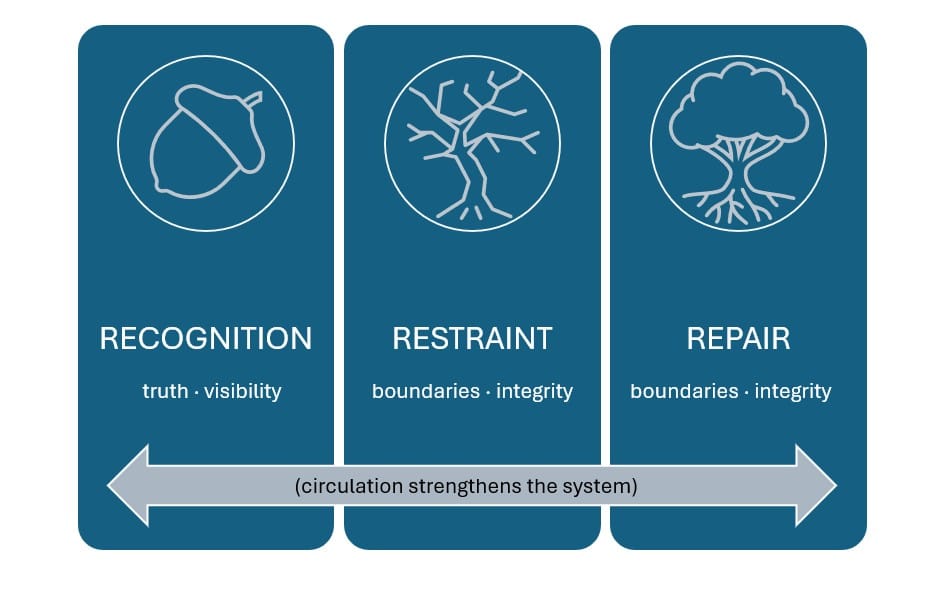
Demir Law describes how living systems stay alive through the circulation of recognition, restraint, and repair. Control, scale, and efficiency interfere with this flow, creating fragility. Life in systems is sustained through circulation, not force

Demir Law
The Life Law of Convivial Systems Theory
Axiom
Systems stay alive through circulation.
Law
The Demir Law names the fundamental condition of living systems: life is sustained not by control, scale, or optimization, but by the quiet circulation of three capacities — recognition, restraint, and repair.
Recognition allows truth to surface.
Restraint prevents harm from spreading.
Repair corrects deviation before fracture occurs.
When these capacities circulate freely, systems remain flexible, humane, and resilient. When any one of them stalls, the system becomes brittle. Control interferes with circulation. Scale dilutes it. Efficiency starves it.
Life in systems is not engineered.
It is recirculated.
Systems Version
If recognition is suppressed, restraint erodes.
If restraint erodes, repair is delayed.
If repair is delayed, drift compounds.
If drift compounds, the system dies.
Soul Version
Life in systems is the product of circulating capacities.
Block the circulation, and fragility appears.
Restore the circulation, and conviviality returns.
Form
Recognize early.
Restrain wisely.
Repair before rupture.
Let these move through every layer:
self → dyad → group → institution → culture.
Friction
Control suffocates recognition.
Scale overwhelms restraint.
Delay corrupts repair.
Performance versions of any of the three destroy their function.
No dashboards.
No forced vulnerability.
No engineered harmony.
The law fails under spectacle.
Outcome
A system that can breathe.
A culture that detects truth before damage.
A group that contains failure before collapse.
A network that strengthens through continuous small corrections.
A structure that stays alive — not by force, but by flow.
Neural Network Mapping
(Circulation vs. control in learning systems)
In learning systems, Demir Law appears as the necessity of circulating signal, constraint, and correction. Models remain stable when feedback is allowed to propagate, gradients are bounded, and errors are corrected early. Excessive control, over-optimization, or delayed correction produces brittleness and collapse.
In ML terms:
signal must circulate,
constraints must bound,
correction must occur early.
Training fails not because models are large, but because circulation is blocked.