
SYSTEMS & SOUL · SYSTEM DIAGNOSTICS
System Diagnostics is a collection of tools that help you see the structure beneath the moment. Each diagnostic reveals drift, distortion, alignment, or truth inside human systems. Quiet tests for clear seeing and correct action.

SYSTEM DIAGNOSTICS
A set of tools that reveal the structure beneath the moment.
Diagnostics are not judgments.
They are tests.
Each one names a recurring pattern in human systems.
Each one provides a way to sense alignment, distortion, or drift.
Use them quietly.
Use them early.
Use them to see what is usually hidden.
Gold Litmus Test
Question
Would you trust this person with uncounted gold or watching your children.
Systems Use
Compare actual trust with performed competence. Reveals hidden instability in the system.
Soul Application
If the answer is no, your nervous system already knows the truth.
Relief Test
Question
Does imagining an exit bring relief.
Systems Use
Remove or isolate outliers. Observe whether system behavior improves.
Soul Application
Relief is information.
You are carrying load that is not yours.
Delight as Compass Diagnostic
Question
Does delight appear when you imagine moving toward this path, or does the idea fall flat.
Systems Use
Treat delight as an early indicator of sustainable direction.
Actions that generate a small spark of energy often scale.
Actions that generate deadness signal misalignment before failure occurs.
Soul Application
Delight is information.
It points toward what feels alive in you, not what you perform for others.
Children play.
Not strategically.
Not: “Monkey bars for arms, seesaw for legs.”
They follow delight —
their first compass.
So should we.
Pollarding vs Pruning Test
Question
Is this a light trim or a structural reset.
Systems Use
Distinguish between minor tuning and core redesign.
Soul Application
If overwhelmed, pollard the system.
Cut back to essentials; rebuild later.
Elegant Restraint Test
Question
Should this even be done.
Systems Use
Prevents unnecessary complexity. Encourages architectural discipline.
Soul Application
The move you do not make is sometimes the move that protects your future.
Pulse Calibration Test
Question
Is this a pulse or a push.
Systems Use
Systems work in oscillation. Detect when rhythm is needed instead of force.
Soul Application
Work in pulses.
Rest deliberately.
Do not confuse exhaustion for virtue.
Pre-Indexed Schema Diagnostic
Question
Do you have a place for this information to land.
Systems Use
Ontology must precede analysis. Without structure, data becomes noise.
Soul Application
Confusion means a folder is missing.
Build the folder, then return to the idea.
Drift Detection Test
Question
Where has the small drift begun.
Systems Use
Tracks micro-changes before they become structural faults.
Soul Application
Small drift requires small correction.
Early detection prevents rupture.
Three Regimes of System Failure Diagnostic
Signal
A system is failing, but the failure does not come from a single cause. It arises from a specific combination of two variables: the system’s ability to discriminate quality, and its willingness to act.
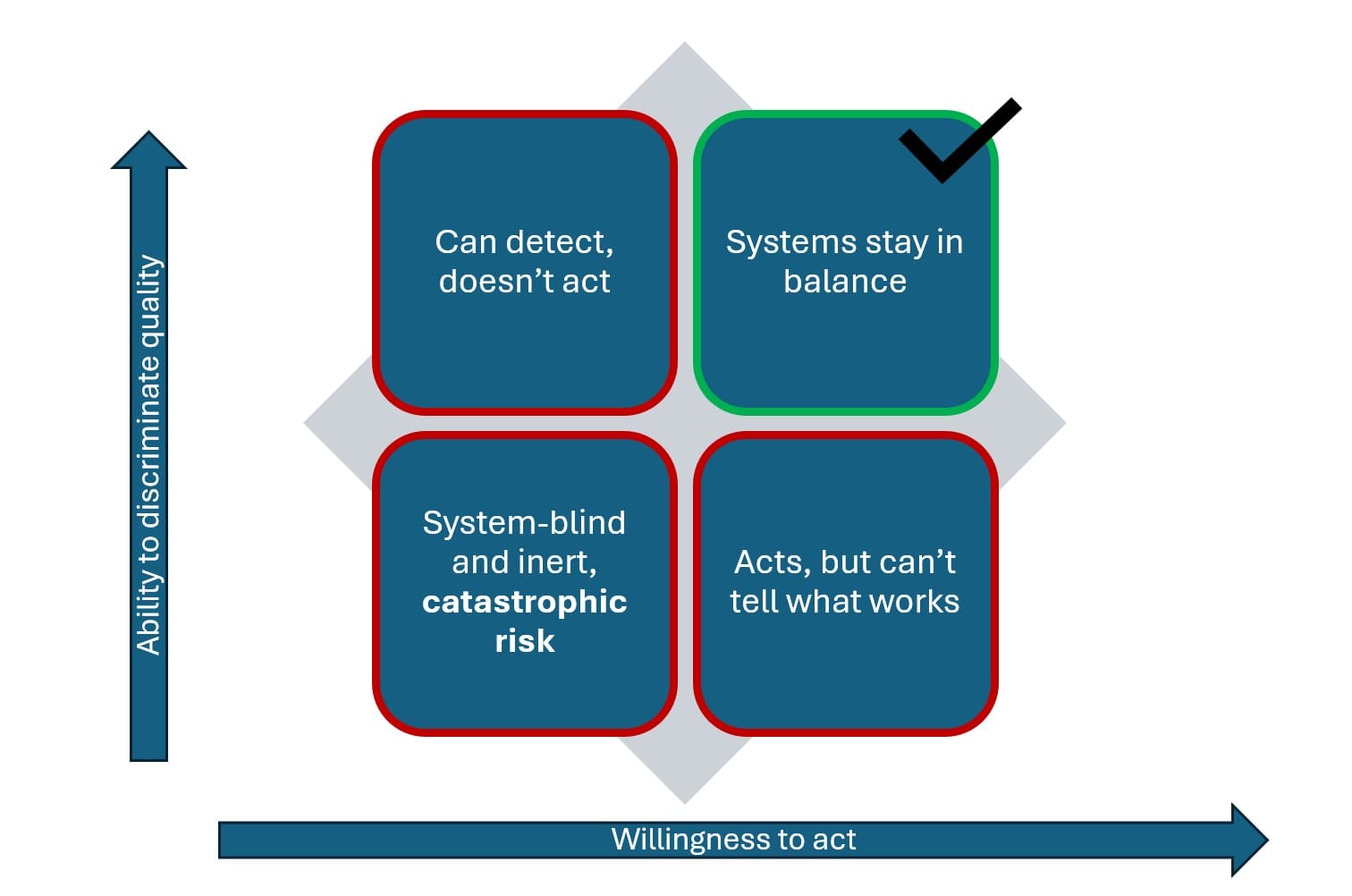
Interpretation
Not all system failure is the same.
Some systems can detect what is wrong but fail to intervene.
Some intervene constantly but cannot tell what works.
Some do neither, and move toward catastrophic risk.
Only systems that can both discriminate quality and act on it remain in balance.
Put plainly:
A system can fail by blindness.
A system can fail by paralysis.
A system can fail by blunt force.
The repair depends on the regime.
Systems Use
Use this diagnostic to evaluate:
• public systems that detect failure but do not respond
• bureaucracies that generate reports without corrective action
• organizations that act performatively without feedback discipline
• infrastructure systems where intervention is decoupled from quality sensing
• governance environments where the wrong repair is repeatedly applied to the wrong failure mode
• high-risk systems where blindness and inertia compound into catastrophic exposure
This diagnostic helps identify not just whether a system is failing, but what kind of failure is taking place, and therefore what kind of repair has a chance of working.
Boundary Notes
This is not a general metaphor for “things going wrong.”
It is a classification tool for locating failure by regime.
It does not ask whether people care.
It asks whether the system can tell quality apart, and whether it will act on what it knows.
A highly motivated system can still fail if it cannot discriminate quality.
A highly perceptive system can still fail if it refuses to act.
Failure Mode if Ignored
If you fail to distinguish the regime, you may:
apply action to a system that lacks discrimination
apply analysis to a system that already knows but will not act
misread catastrophic blindness as ordinary delay
mistake activity for repair
treat stable balance and unstable intervention as if they were the same
The result is predictable:
the wrong remedy, applied repeatedly, to the wrong system failure.
Related Essay
Three Regimes of System Failure
This diagnostic corresponds to the essay Three Regimes of System Failure, which develops the underlying logic in fuller form. The essay shows why systems cannot be repaired generically, because failure looks different depending on whether the system can distinguish quality, is willing to act, both, or neither.
The Employment Theater Signal
Name
The Employment Theater Signal
Signal
A role emphasizes enthusiasm, positivity, or “bringing energy” as part of the job description — especially when those traits are required to “succeed” in the role.
Interpretation
When emotional performance becomes a core expectation, it often means:
the underlying system has lost substance
and
the structure can no longer rely on actual value creation.
Enthusiasm fills the void where structural competence, clarity, or genuine contribution should be.
Put plainly:
Real work creates value.
Theater creates mood.
If the system demands mood, not value, something upstream is hollow.
Systems Use
Use this diagnostic to evaluate:
- organizations compensating for structural decay
- teams where morale is substituted for meaning
- roles where optics outweigh output
- workplaces where “staying positive” is enforced
- environments where energy masking hides drift or dysfunction
This diagnostic quickly reveals when an institution is propping up the façade of health because the real system is weakened underneath.
Boundary Notes
This is not a critique of emotional labor itself —
it is a warning that excess emotional demand is often a smoke signal for systemic weakness.
Failure Mode if Ignored
If you accept theater as normal, you may miss:
- collapsing value chains
- disguised role redundancy
- low-consequence roles (LCRs) masquerading as critical
- systems that still appear “high morale” right before they fail
Minimum Promise Boundary Check
Question
Has a silent promise been violated.
Systems Use
Most systems fail on implicit contract breaches, not explicit ones.
Soul Application
Your dignity lives at the boundary floor.
Honor what your soul knows is required.
Archetype Integrity Test
Question
Is the stabilizing archetype being harmed.
Systems Use
Locate the agent carrying the most load. Protect them.
Soul Application
If you are the stabilizer, guard your integrity.
Do not let the system optimize against you.
Fairness Floor Test
Question
Is fairness drifting below dignity threshold.
Systems Use
Detect the moment when asymmetry turns corrosive.
Soul Application
Fairness is not niceness.
It is structural.
Incentive Stability Check
Question
Are the incentives stable.
Systems Use
Unstable incentives create erratic or hostile behavior in otherwise stable systems.
Soul Application
Hold incentives steady.
Chaos often reveals itself as misaligned reward.
Distortion Detection Test
Question
Has noise overtaken signal.
Systems Use
A high-noise system cannot produce reliable output.
Soul Application
Seek a calm sea to interpret truth.
Novelty Override Test
Question
Has familiarity blinded perception.
Systems Use
Without contrast, shifts go unseen.
Soul Application
Introduce small novelty.
Reset your ability to see clearly.
Cognitive Load Test
Question
Is this beyond interpretability.
Systems Use
Systems fail when cognitive load exceeds working capacity.
Soul Application
Simplify.
Reduce inputs.
Clarity returns when load drops.
Frame Dynamics Diagnostic
Question
Who is controlling the frame of the moment.
Systems Use
Frames carry power.
If someone sets the emotional frame, they set the room.
Soul Application
Notice when discomfort is being used as dominance.
Choose frame inversion or frame refusal.
Frame Inversion Diagnostic
Question
Who is being positioned as the one who should feel discomfort, and who remains comfortable while doing it.
Systems Use
Groups sometimes weaponize ease.
The person or subgroup displaying casual dominance sets the emotional frame.
If the person “on the back foot” is actually the one reading the structure — not the content — the frame is already beginning to invert.
Soul Application
When the tactic becomes visible, the spell breaks.
Seeing the move is the first act of agency.
The frame shifts the moment you refuse the part they cast for you.
Shame Load Test
Question
Is shame making emotional contact intolerable.
Systems Use
High shame load blocks communication regardless of logic.
Systems break at the point of intolerable emotional exposure.
Soul Application
Lower the temperature first.
No repair can begin while shame saturates the system.
Signal-to-Noise Diagnostic
Question
Is the signal detectable at all.
Systems Use
Signal cannot be extracted from turbulent systems.
Noise reduction precedes clarity.
Soul Application
Calm the environment, then reassess.
Insight belongs to quiet rooms.
Recognition Deficit Test
Question
Is the system starving for acknowledgment.
Systems Use
Recognition is a stabilizing currency that systems pretend not to count.
Deficits show up as friction, resentment, and drift.
Soul Application
People thrive when seen.
Starvation creates collapse.
Boundary Floor Stress Test
Question
Has the minimum dignity condition been crossed.
Systems Use
Systems violate floors long before breaking ceilings.
Early detection of floor breach predicts failure.
Soul Application
Protect your floor.
If the floor collapses, the relationship collapses.