
SYSTEMS IN ACTION · Campus Monetization: The Perimeter Play
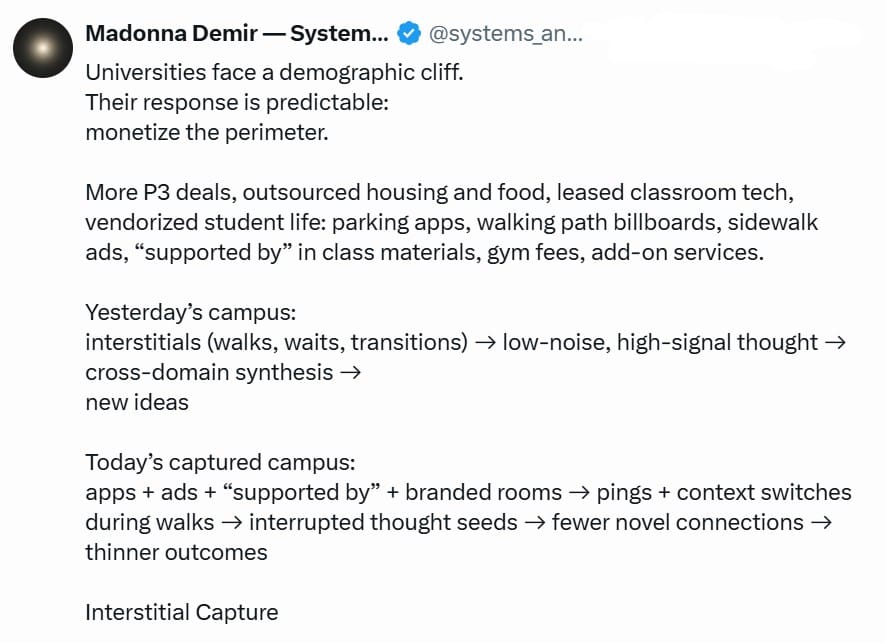
Universities facing a demographic cliff are monetizing the perimeter through P3 deals, vendorized student life, and campus advertising. The hidden cost is cognitive: when interstitial spaces become attention surfaces, cross domain synthesis collapses quietly.

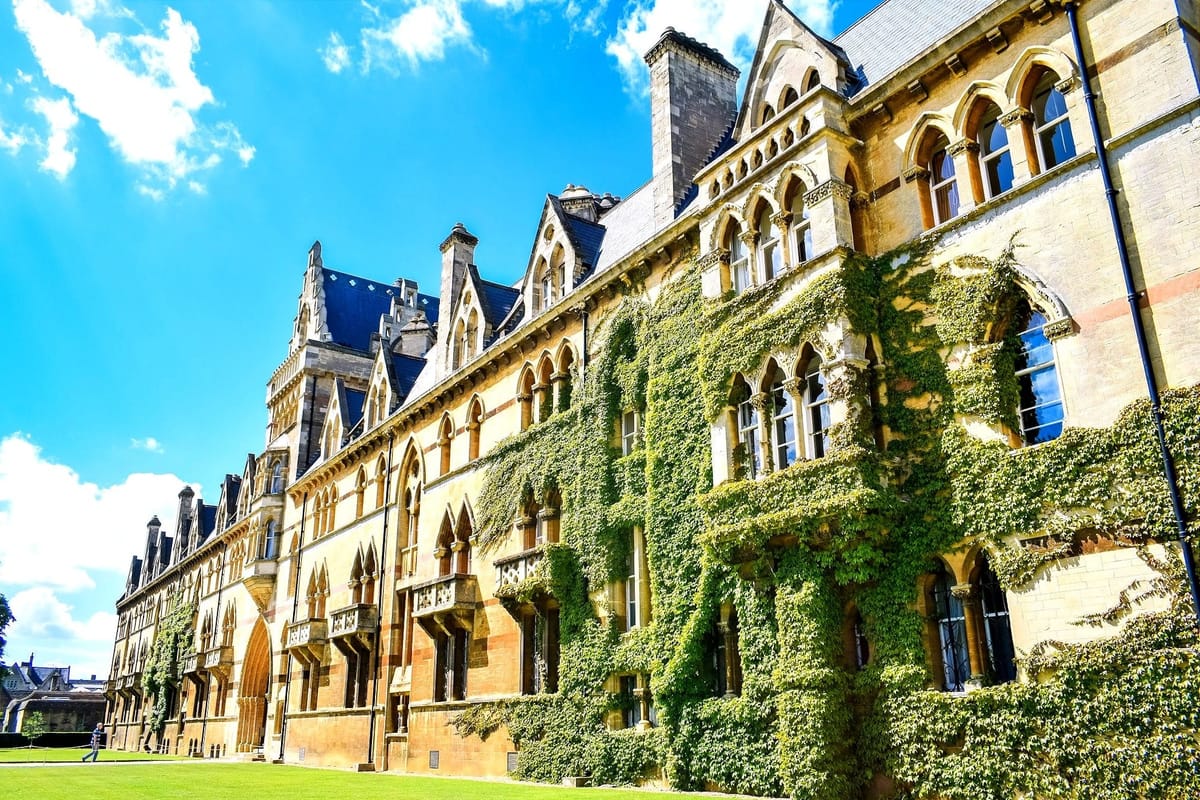
What happens when campuses monetize the corridor where ideas are born?
The walk between physics and sociology
I remember walking through a university campus that felt, in a quiet way, like it belonged to learning. Between physics and sociology, there were ten minutes of landscaped path. This time between classes was just long enough for one domain to begin talking to another in the small combinatory way that makes real thinking possible. A concept from one class would snag on a detail from another. My mind would test the connection, reject it, try again, and sometimes a third thing would appear. Not a “breakthrough,” but a synthesis.
In this case, I was thinking of vectors, forces interacting at angles, and how the same thing was true for social systems. Some outcomes aren’t the product of a single force applied in a straight line. They emerge from interactions, from oblique pressures that compound and redirect each other, sometimes additive, sometimes counteracting.
That synthesis did not happen in class. It happened in the space between classes, while my body moved and my mind had a silent playscape. The interstitial space, the walk, the wait, the transition between physics and sociology, functioned like an integration layer. It was where my brain compiled the day’s inputs without being asked to perform, respond, or transact.
The demographic cliff and the predictable response
Universities are now facing a demographic cliff: fewer university-age students. Their institutional response is predictable, because it is legible to finance and controllable by contract. They monetize the perimeter.

The perimeter is where the P3 deals live. They are attractive for the same reason vendor stacks are attractive in other sectors: fast monetization, less up-front capital, and a contract that turns messy operations into a predictable payment stream. Alongside them sit outsourced housing and food, leased classroom technology, and vendorized student life. Monetization shows up as parking apps, walking-path billboards, sidewalk ads, “supported by” stamps in class materials, branded buildings and classrooms, add-on student services, gym fees, and branded services. The pitch is consistently framed as modernization, revenue diversification, and partnership. It is careful to imply that none of this touches the sacred core of its educational mission.
None of these contracts price the cognitive externality.
The perimeter isn’t empty space
The perimeter is not empty space, it is exactly where integration lives. A campus is not only classrooms and syllabi. It is also the in-between where ideas are allowed to cross-pollinate before they are graded, defended, or optimized. When you change what happens in those in-between spaces and corridors, you change what the institution produces, even if the lecture content remains the same.

Yesterday’s campus, at its best, created a low-noise environment for those transitions. Walks, waits, and small gaps in the schedule offered unstructured attention. Beautiful landscapes and quiet walking paths weren’t merely aesthetic. They supported the conditions under which the mind could wander, test, combine, and return with something new. That unstructured attention turned into cross-domain synthesis, and cross-domain synthesis turned into ideas that only appear when thought is given room to explore without interruption.
The captured campus
Today’s captured campus rearranges that sequence. Apps, ads, “supported by” class content, branded rooms, and ad-filled walking paths introduce pings and micro-decisions into the very spaces where thought used to settle. The result is not merely annoyance and distraction. It is the forced insertion of context switches during the precise phase when a half-formed thought is trying to become coherent. Thought seeds get interrupted while they are still fragile, and fragile seeds, interrupted often enough, do not mature into anything sturdy.
One campus advertising network, which claims 500 university campuses, markets the perimeter like this:
Digital Screens
Digital screens, located in student centers, apartments, and other locations on and near campus, offer can’t-miss visibility.
Campus Transit
Campus-dedicated buses circulate throughout campus. Exterior and interior advertising options.
Bus Shelters
Located on or near campus, these large-format displays are on full display and hard to miss.
Campus Kiosks
Campus kiosks are located in buildings and outdoors throughout campus.
Newsstands
Your ad is everywhere the college newspaper is offered throughout campus.
Billboards
Billboards offer traditional out-of-home advertising in high-traffic areas near campus.
Bulletin Board Posters
Installers will place your posters on bulletin boards throughout campus. This can’t-miss media format is seen alongside announcements for campus events and activities.
Street Furniture
Street furniture displays are located on and near campus in highly visible areas.

As a systems claim about cognition under interruption, notice that these dynamics don’t depend on the merit of the ads themselves. The cost is the frequency and inevitability of attention capture, stitched into movement so thoroughly that the mind has fewer places to be unobserved, unmonetized, and uninterrupted.The first casualty is combinatory thought: Novel connections wither.
Cross-domain synthesis thins.
The integration layer is the product
A campus can tolerate many degradations and still deliver something that resembles education. The food can be bad, the buildings can be ugly, the administration can be bloated, and the teaching can be uneven. What it cannot casually disrupt, without consequence, is the integration layer that turns learning into synthesis. If you fragment the corridors and capture the transitions, you should expect thinner outcomes, even if the “core” remains untouched on paper.
Part of the problem is that these changes arrive as small things, each defensible in isolation. A parking app that insists on downloads, payments, and notifications. A required platform login for chemistry that carries a sponsor logo. A QR code on a walkway advertising a nearby club. Brought-to-you-by signs in the cafeteria. A “presented by” slide in a classroom deck. None of these, alone, looks like an assault on education. Each one seems like a pragmatic patch.
Systems rarely fail through a single dramatic decision. They fail through accumulated context switches that nobody is responsible for, because each layer was rationalized as an isolated and incremental improvement.
Naming the pattern
Universities used to sell education, and now they increasingly also sell the surroundings, including the walk to classes, the transitions, the perimeter, and the in-between. When that in-between is monetized, synthesis collapses quietly, and the institution loses something it cannot easily measure until it is gone. The corridor stops being a compiler and becomes an attention surface.
That pattern, the conversion of low-noise interstitial space into an instrumented and monetized attention surface, is what I mean by Interstitial Capture.
Its cost isn’t the vendor fees. It is student thought life, and downstream, a society that gets fewer original connections from one of its key synthesis machines.
Provenance
Originally developed as a standalone flow diagram on X.
Formalized as Interstitial Capture Doctrine.
See more field tests → Systems in Action
 Madonna Demir
Read another SIA here, Hall of Wisdom