
Integrating Demir’s Step 0 With Coleman’s Reconciliation Ladder: Pre-Contact Interventions in Family Estrangement for Clinicians
Most estrangement frameworks begin too late, assuming both sides can manage emotional contact. Shame and reactivity can block even skilled attempts. Demir Step 0 supplies the missing on-ramp sequence prior to use of Coleman’s reconciliation ladder.

Pre-Contact Interventions for Family Estrangement
Integrating Demir’s Step 0 With Coleman’s Reconciliation Ladder
“Most reconciliation models begin at Step 1.
Estranged families often cannot even reach Step 0.”
Abstract
Family estrangement frameworks often assume that both parties can tolerate an initial emotional overture. In practice, many dyads cannot. Shame reactivity, defensiveness, cultural constraints, or therapy aversion block even the most careful reconciliation attempts.
This resource outlines Demir’s Step 0, a pre-contact intervention composed of two moves — Enmity Cured and The Path Back — that create the missing on-ramp to Coleman’s reconciliation ladder.
The steps do not replace Coleman. They precede him, increasing the likelihood of success for therapy-resistant or culturally stoic relational systems.
I. Clinical Context: Why a Pre-Contact Step Is Necessary
Estranged families frequently stall at the earliest moment of repair. Common barriers include:
• total communication freeze
• high shame activation
• avoidance or hostility toward therapy
• cultural norms that discourage emotional vulnerability
• fear that a vulnerable overture will be rejected or misinterpreted
Most reconciliation tools assume contact already exists.
Your missing population is the one for whom any emotional start is impossible.
“In estrangement, the first failure point is often before the first step.”
II. The Gap in Coleman’s Ladder
Coleman’s ladder is humane and clinically useful — once communication has restarted.
But clinicians report challenges:
• Step 1 (reconciliation letter) requires emotional exposure
• high freeze rates for clients with shame injuries
• risk of escalation if the letter is misread
• perception of self-blame or groveling
• emotionally avoidant dyads abandon the attempt early
Coleman’s model is not flawed.
It simply operates after a threshold most estranged families cannot cross.
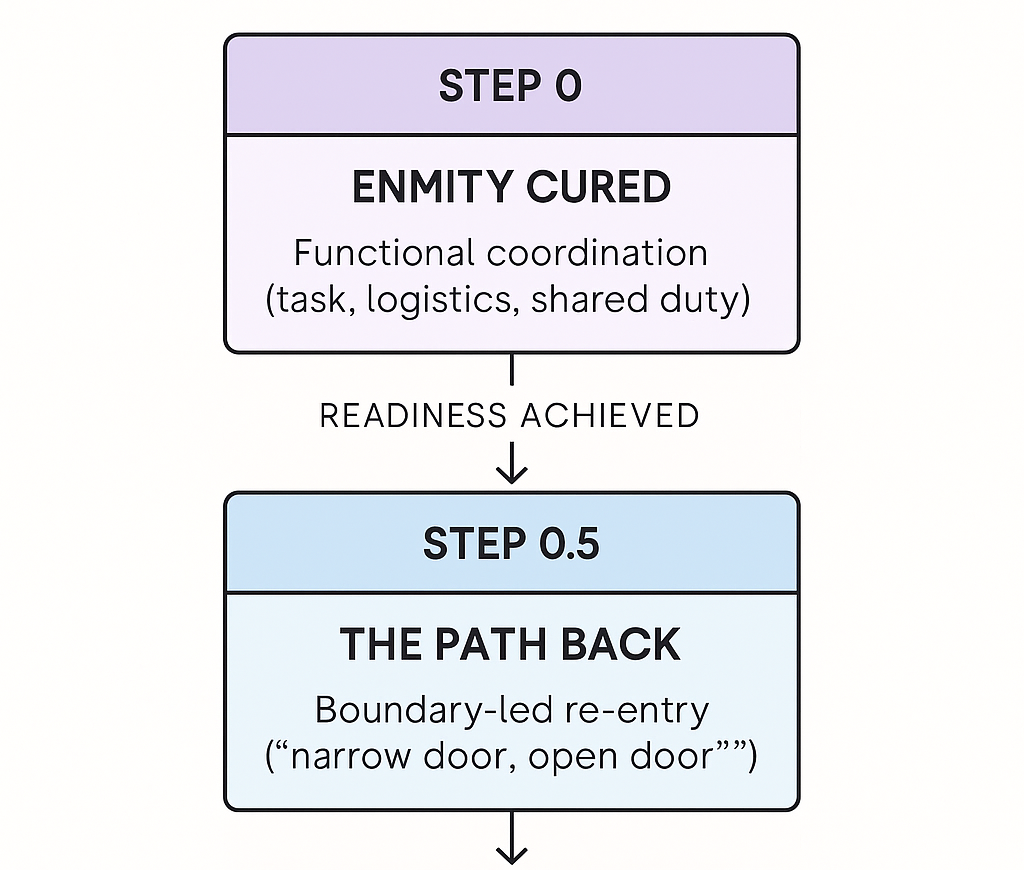
III. Step 0 — Enmity Cured
Functional coordination before emotional repair
Definition
A task-based, shame-free first contact.
It creates alignment without requiring agreement or vulnerability.
Mechanisms
• lowers stakes
• bypasses shame
• preserves dignity
• uses shared tasks rather than shared emotions
• avoids psychological language therapy-resistant individuals reject
Examples clinicians may offer:
• logistics or safety coordination
• shared family duties
• brief cooperation around a practical issue
• relaying essential information without emotional framing
This mirrors micro-alignment strategies used in mediation and family systems work.
See also: Shared Action Doctrine
“The system stabilizes when cooperation becomes easier than enmity.”
IV. Step 0.5 — The Path Back
Boundary-led re-entry
Once minimal contact exists, the dyad needs constraint, not catharsis.
Key doctrine:
“The door stays narrow, and it stays open.”
Narrow
• small, time-limited interactions
• predictable cadence
• no emotional overreach
• containment of intensity
Open
• the invitation to return is steady
• no forced forgiveness
• no dramatic reconciliation moment
This aligns with gradual exposure, Bowenian pacing, and structured re-entry protocols used in reconciliation counseling.
See also: Path Back Doctrine
V. Integrating Step 0 With Coleman’s Ladder
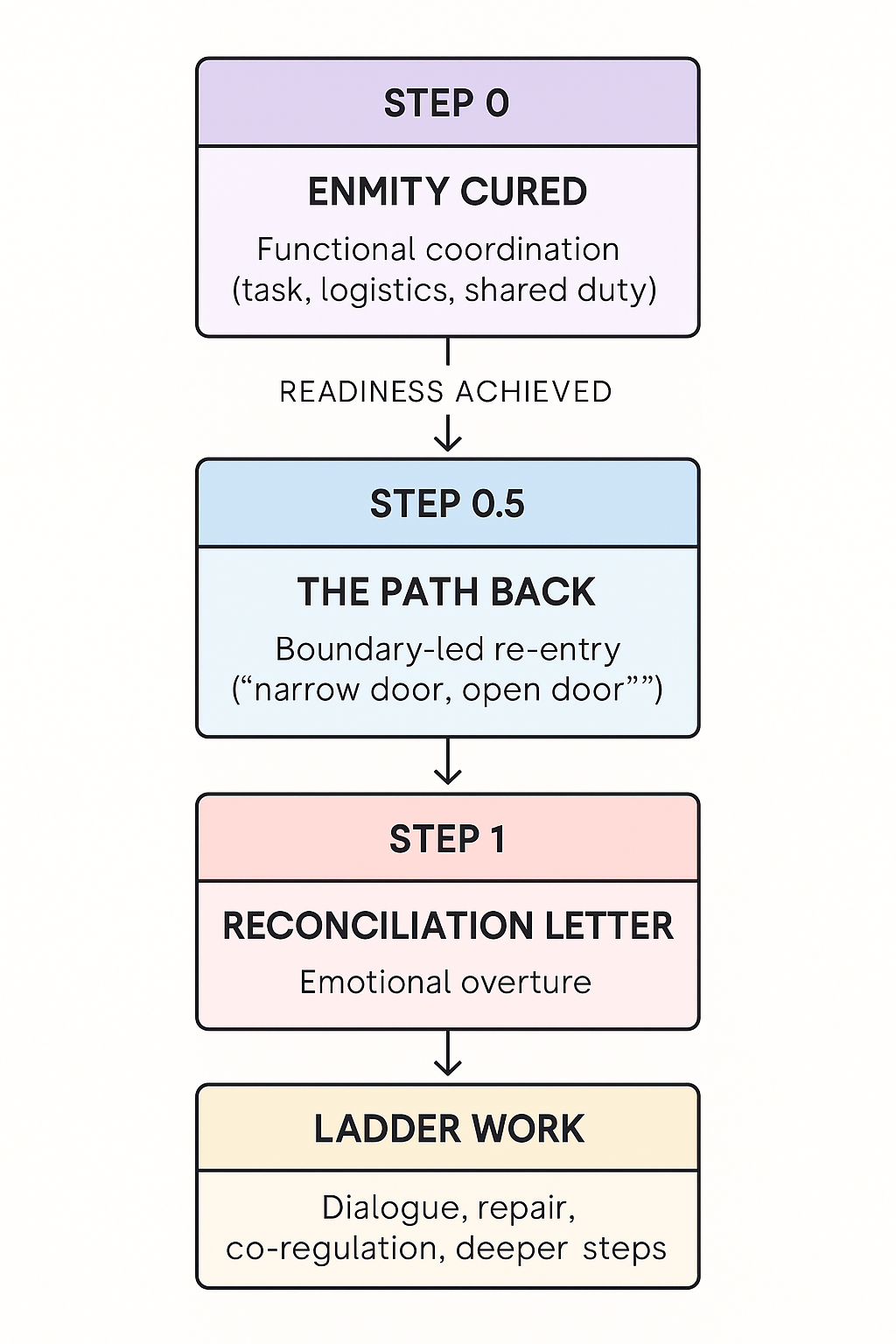
Recommended clinical sequence:
- Step 0 — Enmity Cured
Functional, task-based contact - Step 0.5 — The Path Back
Narrow-door, structured re-engagement - Coleman Step 1 — Reconciliation Letter
Emotional overture once shame and defensiveness are regulated - Coleman Ladder Work
Deeper conversation, repair, co-regulation
This sequencing does not modify Coleman’s framework.
It prepares the family to benefit from it.
“Demir opens the door.
Coleman helps you walk through it.”
VI. Populations for Whom Step 0 Is Clinically Essential
• therapy-averse fathers, uncles, and older male relatives
• rural or working-class systems with stoic cultural norms
• individuals with strong shame avoidance or dignity injuries
• high-conflict dyads with avoidant attachment
• families that reject psychological framing but accept practical coordination
These groups often respond well to functional contact but reject emotional exposure.
VII. Clinical Vignette (Composite)
(Use this as prompt to adapt for your case notes.)
A father and adult son have not spoken in eighteen months.
Attempts at emotional outreach have failed.
The son refuses therapy.
Step 0:
Father sends brief, practical communication about a shared responsibility (insurance, document, or safety issue).
Son replies neutrally.
Cooperation occurs without emotional charge.
Step 0.5:
Father maintains narrow, predictable contact.
No apology pressure. No emotional openings.
Transition:
After several successful practical exchanges, the son messages first.
The clinician introduces Coleman’s Step 1 letter.
Outcome:
Dyad begins ascending Coleman’s ladder without collapse.
VIII. Ethical Considerations
• Step 0 must involve genuine, necessary tasks — not contrived pretexts
• maintain therapist neutrality (no pressured reconciliation)
• avoid coercion or emotional ambush
• pace intervention toward the slower nervous system in the dyad
• respect cultural patterns around dignity, privacy, and agency
IX. Conclusion
Demir’s Step 0 fills a clinically meaningful gap.
It does not challenge Coleman’s model — it makes it reachable.
Functional alignment → structured re-entry → emotional repair.
A complete pathway for families who cannot begin with vulnerability without structure.
X. Diagram — The Full Sequence
XI. Resources and References for Clinicians
For adaptation and use by clinicians, where applicable
References
Coleman, Joshua.
Rules of Estrangement: Why Adult Children Cut Ties and How to Heal the Conflict.
Harmony Books, 2021.
A foundational contemporary resource for understanding estrangement dynamics, particularly from the perspective of estranged parents. Coleman’s “Reconciliation Ladder” (presented across his workshops, interviews, and published guidance) outlines structured steps for re-engagement once communication has reopened.
Coleman, Joshua.
“Reconciliation Ladder.”
Presented in clinical practice, public seminars, and guidance for estranged families. The ladder is widely used in therapeutic contexts as a phased model for rebuilding contact after initial re-entry. (Referenced here for sequencing comparison but not reproduced.)
Bowen, Murray.
Family Therapy in Clinical Practice.
Jason Aronson, 1978.
Classic systems theory source emphasizing differentiation, pacing, and multigenerational process — conceptual grounding for re-entry frameworks.
Kerr, Michael, and Murray Bowen.
Family Evaluation.
W. W. Norton, 1988.
Further articulation of systems pacing and emotional boundary management, relevant to Step 0.5 work.
Gilbert, Paul.
The Compassionate Mind.
Little, Brown, 2009.
Provides evidence-based foundations around shame, threat activation, and why emotional overtures often fail under high shame load.
Johnson, Susan.
The Practice of Emotionally Focused Couple Therapy.
Brunner-Routledge, 2004.
Useful for understanding emotional pacing and controlled re-engagement once basic contact exists.
Reference Notes and Source Context
Coleman’s Reconciliation Ladder
Coleman’s ladder is not a single published graph or table in Rules of Estrangement, but a conceptual framework he teaches across multiple platforms — including therapist trainings, interviews, and parent consultations. The ladder describes phased progression after initial contact has begun.
For ethical citation, we reference the concept but do not reproduce or quote the step-by-step ladder, as Coleman has not formally published the ladder as a standalone replicable chart.
Why Demir Step 0 must precede Coleman
Coleman begins at the moment when a parent is ready to send a reconciliation letter or when an adult child has softened enough to allow emotional material. Demir’s Step 0 (Enmity Cured + The Path Back) addresses the structural gap before that point: creating safe, functional pre-contact for therapy-resistant or shame-sensitive dyads.