
SYSTEMS IN ACTION · The Dutch Hangplek and the Governance of Mischief
American communities keep asking why teenagers gather badly in malls. The Dutch hangplek answers a better question: where are teenagers allowed to gather at all? Why adolescent mischief needs legitimate civic containers before it becomes disorder.

A few days ago, another video moved through the feed: teenagers flooding a shopping mall, bodies packed into retail space, the scene already degraded into shouting, fighting, and thrown merchandise. The responses were immediate and familiar. Where are their parents? Why is this normal now? Why don’t malls impose curfews?
🚨IT HAPPENED AGAIN!!!
— Matt Van Swol (@mattvanswol) May 8, 2026
Now TWO SHOPPING MALLS in Houston TX have now implemented a "YOUTH CURFEW" after HUNDREDS of teens began fighting, screaming, punching, and throwing merchandise.
When did this behavior become normal?!!!
Where are their parents?!!!!! pic.twitter.com/46f6WgyEkv
The frustration is understandable. Retail workers should not have to absorb mob volatility as part of an ordinary shift. Families browsing with toddlers should not have to treat a Saturday afternoon at the mall as a risk calculation. A private mall has every reason to protect its employees, customers, and property when disorder crosses into violence.
Still, the adult question tends to arrive too late in the system. By the time hundreds of teenagers have gathered in a commercial corridor and the only remaining tool is expulsion, the deeper design failure has already happened.
The better question is where teenagers are allowed to exist together.
For decades, American communities have been narrowing the ordinary geography of adolescence. Teens no longer roam neighborhoods on bikes all day. Malls tolerate them only when they are behaving as paying customers. Parks close early or are designed around younger children and supervised family use. Schools manage nearly every minute of the day, while homework, team sports, and club schedules often consume what remains. Homes vary in space, safety, privacy, and hospitality. Some parents no longer feel comfortable sending their teens into other homes. Commercial spaces require spending.
Public space increasingly treats unstructured teen gathering as suspicious. The result is a civic environment that wants teenagers visible enough to monitor, productive enough to praise, and yet absent enough not to disturb adult order.
Adolescent energy, though, does not vanish when adult systems refuse it a place. It pools, gathering steam.
The mall curfew suggested in the X post is a downstream fix. It may be necessary in the short term. Store employees and shoppers need protection. But a curfew is not a teen-space strategy. It is a displacement mechanism.
It answers the immediate operational problem: remove the teenagers from this property.
It does not answer the civic problem: where should they go?
Hangplek
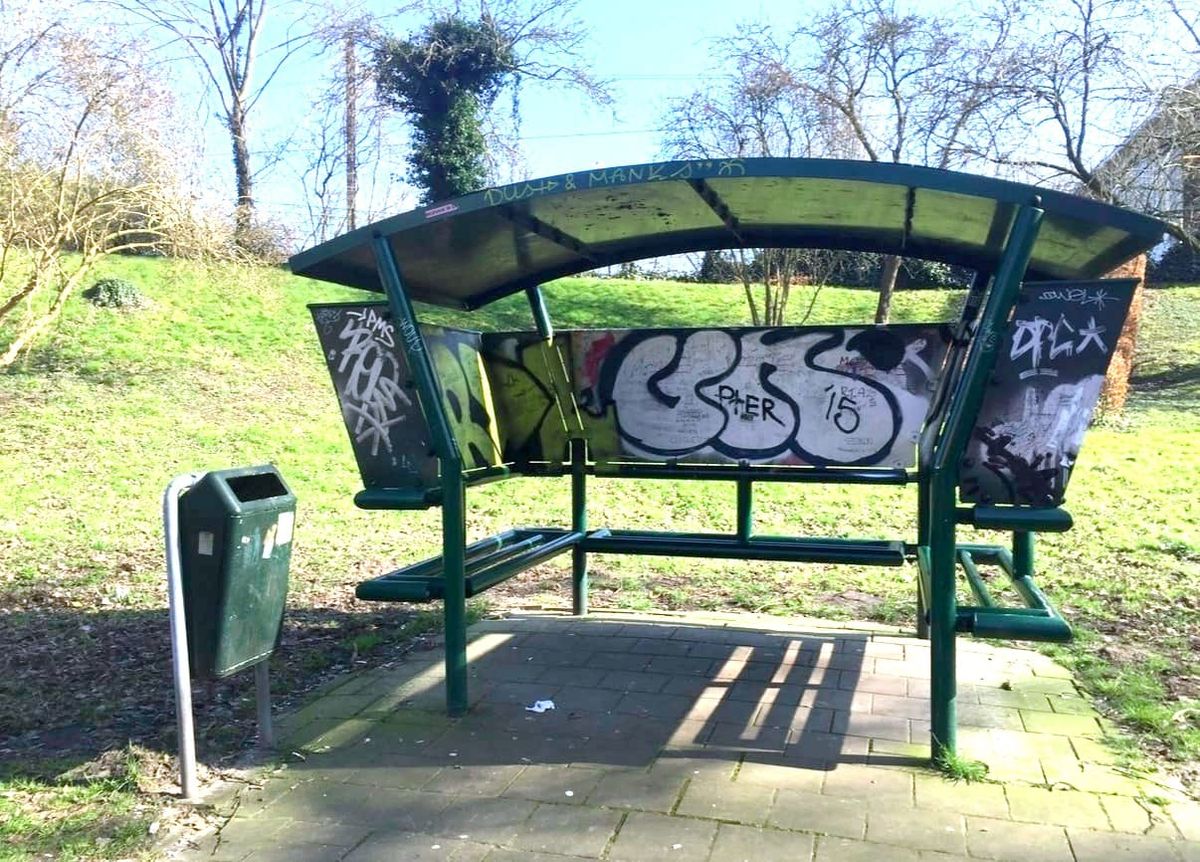
One of the small civic objects I have always admired in the Netherlands is the hangplek, literally a hangout place. The form is modest: a neighborhood shelter, a roof, a few benches, usually a trash can nearby, often graffiti, rarely anything that would win an architectural prize. Its usefulness depends partly on that lack of polish. A hangplek is built for adolescent occupancy rather than adult approval.
It gives teenagers a place that belongs to the in-between. It is outside the house, outside school, outside commerce, outside the playground. It is visible from the neighborhood but socially semi-private. It permits gathering without turning gathering itself into a violation.
The adult posture around it is more interesting than the structure itself. Supervision exists, but loosely. The unspoken rule is that adults pretend not to notice some smoking, drinking, flirting, loudness, or light mischief. They remain close enough to notice and respond if anything serious begins to brew. Ordinary edge behavior is allowed to remain ordinary. Real danger still has intervention nearby.
This is a more sophisticated civic arrangement than it first appears, because it preserves a distinction many brittle systems lose: mischief is not mayhem.
The hangplek takes a different view of human material. It assumes that teenagers need status among peers, some distance from family authority, some relief from constant adult interpretation, and enough privacy to test the edges of themselves. It also assumes that communities retain a legitimate interest in safety, visibility, and interruption when the edges become harmful.
That balance is design intelligence in action. A hangplek is permissive without being abandoned, public without being overexposed, supervised without being too heavily managed by adults. It creates a container for the low-level raucous play through which young people often learn social limits.
Hangplek, Hangjongeren, and JOPs
The Dutch language carries the argument in miniature.
Hangplek is the plain social term: a place to hang around. Hangjongeren, literally “hanging around youth,” is the anxious civic label, usually rendered in English as loitering youth.
Then there is JOP, short for Jongerenontmoetingsplek or JongerenOntmoetingsPlaats, the formal municipal language for a youth meeting place built into Dutch infrastructure.
In these terms, teenagers move through three civic grammars: ordinary presence, public nuisance, and administrative accommodation.
That linguistic spread matters. A society’s vocabulary often reveals whether it can distinguish between behavior to be held, behavior to be redirected, and behavior to be stopped. Some municipal and vendor descriptions of JOPs frame them as places for young people to meet. Others describe them more managerially, as a way to steer hangjongeren away from shopping centers, residential nuisance points, and other contested spaces.
Even that managerial framing contains an admission: gathering will happen somewhere. The design question is whether the system offers a place where it can be held.
Containment is one of the most misunderstood functions in public life. It is a structure that keeps ordinary pressure from becoming structural rupture. Rivers need banks. Boilers need valves. Organizations need informal channels where irritation, dissent, and practical knowledge can surface before they harden into revolt. Cities need third places where people can gather without first becoming consumers.
Teenagers need the same thing.
When teen third spaces disappear, the remaining options become too rigid. A teenager can be at home, under school authority, inside a paid venue, or in trouble. That is a thin map for a developmental stage defined by testing, affiliation, display, and separation.
Energy denied a legitimate container does not disappear. It reappears where the system has less ability to govern it.
The Dutch hangplek is a small but potent answer. It does not romanticize teenagers, nor does it require adults to pretend that all youth behavior is harmless. It simply recognizes that a community which provides no legitimate container for mischief will eventually meet that mischief in a less governable form.
The hangplek is a minor object with major civic wisdom inside it. It admits that young people need somewhere to be a little bit unsupervised without being fully unseen. Many communities would rather denounce that need than design for it.
Then they act surprised when the mall becomes the hangout place.
A healthy neighborhood does not eliminate adolescent mischief. It gives it, and teenagers themselves, somewhere to mature.