
SYSTEMS IN ACTION · Why LED Speed Signs Create New Hazards
Tennessee’s new LED speed-limit signs were meant to modernize safety. Instead, they break long-established cue structures and misalign with human perception, creating new hazards. A look at how dynamic interfaces fail when behavior and context remain static.

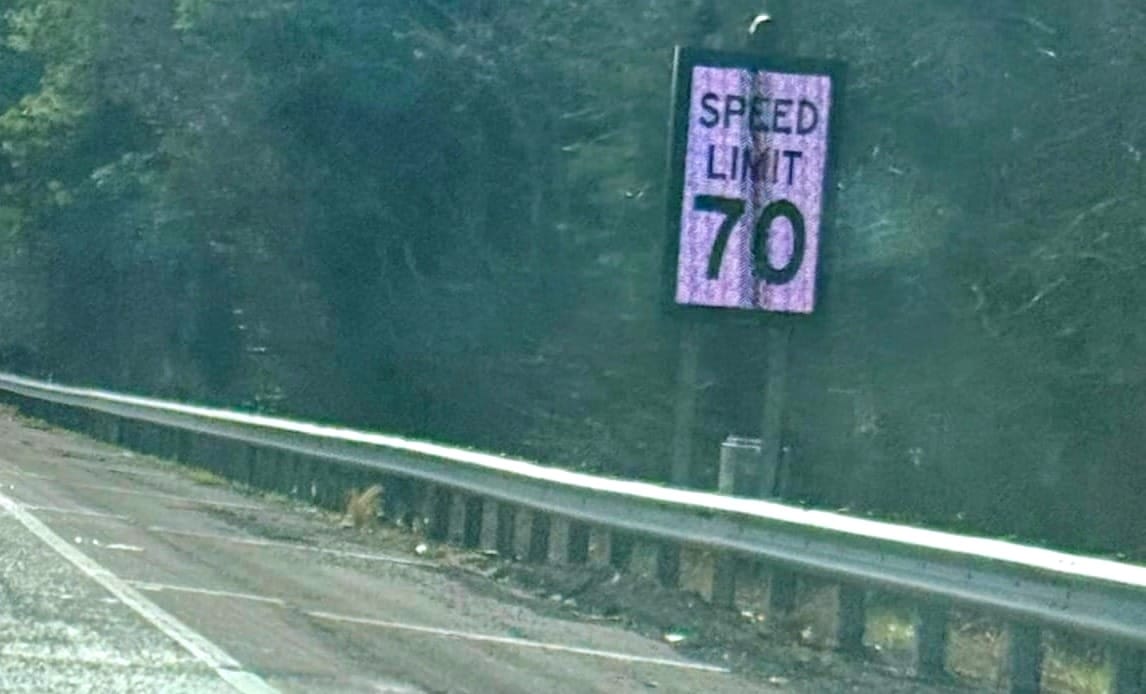
THE SCENE
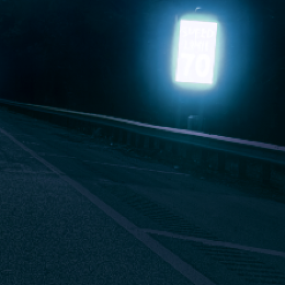
Driving down I-75 through Tennessee, I glanced at one of the new LED speed-limit signs and immediately had to look away. The brightness overwhelmed the information; my eyes shut before my brain could process the number. Most drivers do not consciously read speed-limit signs on familiar routes. We learn them once, encode them as stable, and then rely on low-level habit rather than constant visual parsing.
When limits change temporarily, the system alerts us through a well-understood pattern: orange construction-style signs instead of white, different placement (often left side of road rather than right), portable stands weighted with bright barrels. Color, position, and context signal that the driver must re-engage higher attention.
The new LED signs collapse that cue structure. They are fixed in the usual location, use the usual format, and then ask drivers to treat a previously static rule as dynamic, while also emitting enough light to trigger a pain response.
Instead of improving safety, they introduce a new hazard: drivers are forced either to be temporarily blinded or to look away while driving.
THE PITCH
It is not hard to reconstruct how the decision was made.
At some point a vendor offered a persuasive modernization pitch: the state could adjust speed limits with a simple interface, triggered manually by computer or phone interface or even tied to weather systems.
In theory, speed limits could drop automatically in high winds, thunderstorms, fog, or congestion.
On paper, it read like an upgrade.
In practice, it created forced dependencies.
The vendor’s delight can be anticipated, because every “modernization” layer comes with a recurring revenue stream: SaaS contracts for the variable-speed apps (likely two — one manual and one weather-triggered), integrations that require ongoing licensing, and newly necessary maintenance agreements for the LED hardware. The bulbs and boards fail far more often than a coat of reflective paint ever did, which means scheduled replacements, diagnostics, and service calls become permanent fixtures of the budget.
What looked like innovation was really the quiet construction of a dependency stack — one the public pays for long after the vendor has left the room.
THE MISMATCH
The pitch assumed that drivers would treat speed limits as live data. But human behavior does not work that way.
On familiar roads, as already described, drivers do not consciously read speed-limit signs after the first few exposures. The number becomes part of a stable mental map, handled by lower-level processing rather than active attention. A rule that was once static cannot suddenly become dynamic without changing how the cue is delivered.
Temporary changes already have a well-understood visual language. Orange construction signs, left-side placement, portable stands weighted with bright barrels — these elements signal that the driver must re-engage higher attention. They create context. They distinguish exception from routine.
The new LED signs erase that distinction. They occupy the same physical location as the old static signs, use the same white regulatory format, and then expect the brain to treat them as variable. They introduce a dynamic rule into a schema built on stability, without altering the cues that tell a driver to shift out of automatic mode.
The result is predictable. Drivers glance reflexively, encounter a burst of excessive brightness, and either close their eyes or look away — at precisely the moment when attention is needed most.
A system intended to increase safety instead creates a new hazard by misaligning the design with the way human perception and habit actually function.
A mismatch between human cognitive patterns and engineered flexibility does not produce a smarter road. It produces predictable destabilization.
THE SYSTEM UNDERNEATH
The problem isn’t the signs.
It is the capability hollowing behind them.
Modernization added a dynamic system
to an infrastructure run by static governance.
This is not a signage problem. It is a case of regulatory accretion — where a new rule introduces layers of technical stack and vendor dependency faster than the system’s ability to govern or absorb them.
As that stack deepens, core functions move outside institutional control — a classic case of vendor stack fragility, where accountability blurs and small upstream failures propagate disproportionately.
The engineers who once modeled road behavior, load curves, and driver response cycles have been replaced by vendor dependencies and policy layers that do not understand the system they are modifying.
THE MECHANISM
A variable-speed system requires:
real-time context modeling
feedback loops on driver behavior
calibration logic
clear responsibility chains
fail-safes
validation procedures
real-time context modeling
to assess weather, congestion, visibility, and road conditions before changing a speed limit.
feedback loops on driver behavior
to detect how drivers actually respond to the changing limits and whether the changes cause instability.
calibration logic
to determine when a weather or traffic event is significant enough to justify lowering the limit, and when it is not.
clear responsibility chains
to specify who monitors conditions, who authorizes changes, and who is accountable for misalignment between the displayed limit and the driving environment.
fail-safes
to prevent unsafe or contradictory limits from being displayed, and to revert the system to a known stable state if inputs or sensors fail.
validation procedures
to confirm that the dynamic LED signs improve safety more effectively than the established temporary-speed signage drivers already understand.
Tennessee has the signs. It is not yet clear that it has the architecture required to assess and run them. What looks like modernization is actually an incentive shift: convenience and administrative efficiency are rewarded, while perceptual safety costs are pushed onto drivers. This pattern reflects the Incentive Surface Doctrine.
If this was a test, it revealed the problem clearly: the interface changed; the cue structure did not. Nor, predictably, did human behavior.
This is a classic case of:
Regulatory Accretion → Vendor Substitution → Capability Loss → System Misalignment.
THE CONSEQUENCE
A safety system depends on cue clarity. Calm Sea Doctrine. Stable rules settle into habit; temporary changes rely on markers that interrupt those deep layers of habit.
The LED signs break that cue structure. Their design rewrites the rule that speed-limit signs are stable and predictable. A sign drivers have treated as fixed for decades can now change without warning, yet without any of the context that tells the brain to shift into high-attention mode. The result is no prompt to overwrite the learned system, only confusion inside it.
The road system then behaves unpredictably at the perceptual level. Some drivers slow abruptly because they interpret the brightness as urgency. Others avert their eyes to protect their vision and miss the number entirely. Many default to their prior knowledge of the road because the new rule does not announce itself as new. A few attempt to interpret the sign while adjusting their gaze away from the glare. In all cases, the cognitive load shifts from driving to deciphering.
Instead of creating clarity, the signs create micro-blindness, hesitation, uneven speed behavior and subtle coordination failures between vehicles. Small disruptions propagate quickly in traffic systems. The outcome is not safer movement, but reduced trust in the signals that govern the road.
A system built to refine driver behavior ends up degrading it. The interaction between design and perception produces the opposite of the intended effect.
THE PATTERN
This failure does not belong to Tennessee alone. It is part of a wider pattern in which engineered systems become more dynamic while the human and institutional structures around them remain static.
The road system then behaves unpredictably at the perceptual level; a mismatch between what the technology can do and what the people using it are prepared to register.
The same dynamic appears when a system gains efficiency by pushing risk downward. It is cheaper to reset a variable speed limit from a computer than to place an orange sign on the road with barrels and crews, but the savings come by shifting cognitive burden and safety risk onto drivers. What improves the system’s efficiency degrades the driving environment.
The administrative layer gains convenience; the drivers absorb the cost in distraction, uncertainty and momentary blindness.
The pattern repeats across domains. It appears when offices install real-time performance software without training managers to understand variability.
It appears when hospitals adopt automated triage tools that flood clinicians with alerts they cannot meaningfully act on. It appears when banks modernize internal systems and change underlying account identifiers.
ACH transfers fail. Payroll doesn't hit.
Obligations don’t clear.
The system updates instantly.
The human absorbs the failure.
In each case, the technology promises responsiveness, flexibility and data-driven improvement. What it delivers, without corresponding changes in cue structure and human expectation, is cognitive noise. The system gains new degrees of freedom while its operators behave according to older, more stable patterns. The gap between design and use becomes the site of failure.
This is the predictable consequence of treating modernization as the addition of features rather than the alignment of incentives, perception and context.
A dynamic surface placed on top of a static behavioral model does not create safety. It creates instability that begins subtly and then becomes structural.
A modern interface
on top of a hollowed-out system
creates the appearance of intelligence
and the reality of fragility.
CLOSING THOUGHT
A system is only as modern as the competence that governs it.
ADDENDUMS
A. Field Checklist
Observable MUTCD Drift in Variable LED Speed Limit Signs
Checklist so that a citizen, engineer, or regulator can document issues.
Think of it as operational falsifiability.
B. Systems-in-Action Addendum
MUTCD Compliance vs Human Calibration
The MUTCD assumes a world where regulatory cues are stable.
Speed limit signs are designed to be boring on purpose.
Their power comes from predictability, not responsiveness. When a driver sees a speed limit sign, they are not just reading a number. They are anchoring their behavior to a known rule that will not change without cause.
Variable LED speed limit signs invert this assumption.
Variable LED speed limit signs make the most legally consequential instruction on the road also the least stable. The system asks drivers to continuously re-interpret what “the rule” is, often without visible explanation. In doing so, it shifts cognitive burden from infrastructure to human judgment.
On paper, many of these systems could be found to be MUTCD-compliant.
In practice, they erode the very cue reliability the MUTCD was designed to protect.
This is the gap.
The manual governs what a sign is allowed to display.
It does not govern how frequently humans can be asked to recalibrate.
When speed limits change without clear cause, drivers stop trusting the signal. They slow early, hesitate, or ignore it entirely. Variance increases. Enforcement becomes ambiguous. Safety degrades.
This is not a failure of drivers.
It is a failure of systems that optimize responsiveness without respecting human calibration limits.
A compliant sign that breaks cue trust is still a broken system.
C. Systems-in-Action Addendum Summary
In the USA, temporary traffic control uses orange signs with black lettering/symbols, often with barrels, cones, and barricades, to warn drivers of work zones, guide traffic with reduced speeds (Temporary Speed Limit signs), and direct detours, all following Manual on Uniform Traffic Control Devices (MUTCD) standards for safety and compliance, with penalties for ignoring them. These signs, like "ROAD WORK NEXT XX MILES," use high-visibility colors (fluorescent orange/yellow-orange) to protect crews and drivers through lane shifts, closures, or altered traffic patterns, creating a "Temporary Traffic Control Zone". Key Components & Meanings:
- Orange Color: Signifies a temporary condition, like road work or an incident.
- Barrels & Cones: Physical barriers (drums with orange/white stripes) to channel traffic, create buffers, and block off work areas.
- Temporary Speed Limit Signs: Specific orange signs (e.g., "SPEED LIMIT 45") indicating a reduced legal speed in the zone, often with flashing lights or radar trailers to enforce compliance.
- Work Zone Signs: Warning (diamond shape, orange/black) or Regulatory (rectangular, orange/black) signs for guidance, like "ROAD WORK AHEAD," "LANE CLOSED," or detour arrows.
- Work Zones (Activity Areas): Designated by these devices, protecting workers, equipment, and the traveling public.
Why They're Used:
- Safety: To separate workers from vehicles and prevent drivers from entering hazardous areas.
- Information: To inform drivers of lane shifts, closures, or unusual conditions ahead.
- Compliance: Violating these signs (e.g., driving through barricades, ignoring speed limits) carries significant fines and points, as it endangers lives.