
When the Wheel Turns Itself
Driving is one of the last places where strangers cooperate in real time. As autonomous cars rise, we risk losing the daily practice of attention, generosity, and shared responsibility that once shaped civic life.

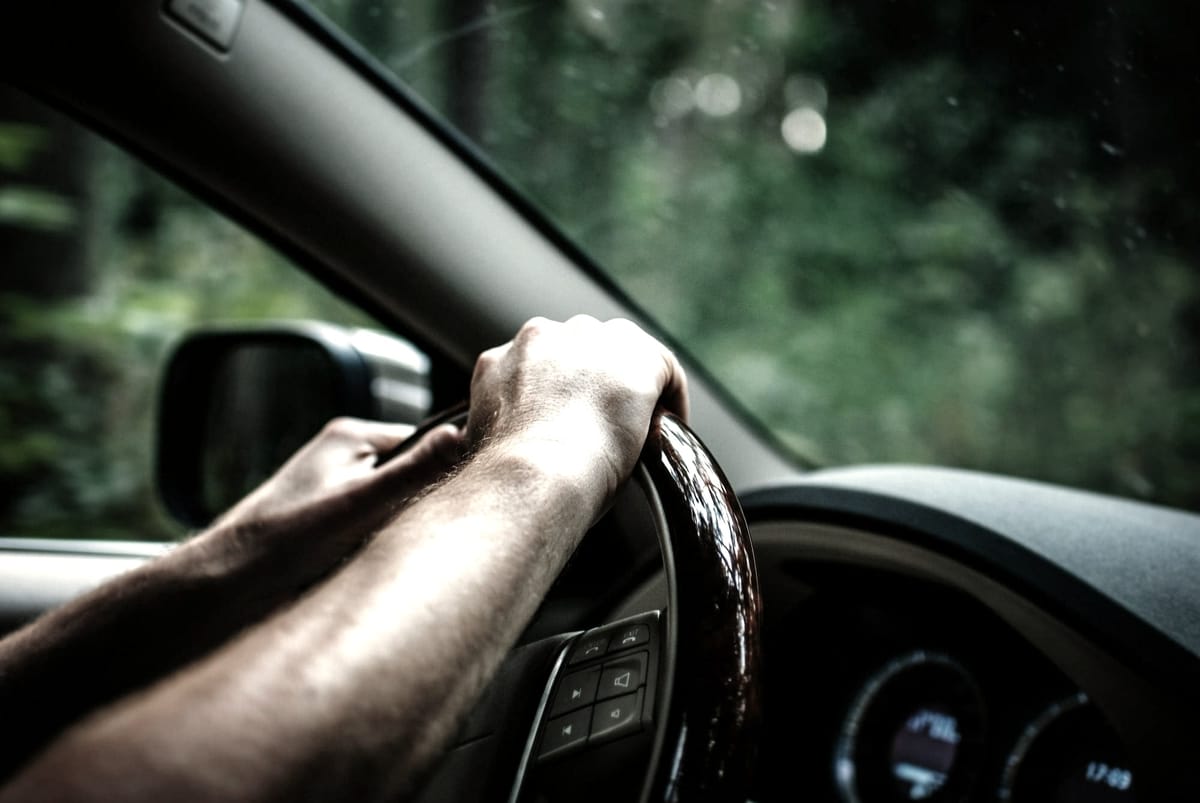
When you drive, you’re doing more than steering a vehicle.
You’re participating in a quiet dance of constant, mutual regard.
The light turned green.
I looked both ways.
A mother was crossing with her baby.
I waved her through.
And I wondered:
What happens
when the wheel turns itself?
Driving looks mechanical. It never was. It is one of the last remaining places in modern life where strangers cooperate at scale and in real time under conditions of shared risk.
You touch the wheel.
You touch an entire social system, a woven fabric of cooperation.
Everything else follows from that recognition.
A Moment at the Light
I was waiting at the stoplight, singing along to my favorite tune, and the light turned green. Before accelerating, I glanced left and right. A mother stepped off the curb, maneuvering a baby stroller in front of her.
I kept my foot on the brake. Smiled. She hesitated, saw the empty lane, and crossed.
“Aw,” I thought, as a brief warmth opened in my chest, then eased forward and continued on my way.
This was not a sentimental moment. It was the small, unspoken work of social coordination. The world stays intact because of millions of these coordinated moments, carried out daily.
Driving as Social Cognition
Driving forces the mind into a specific posture that blends attention, prediction, bodily awareness, and a constant orientation toward the lives of others.
On the surface, you’re watching the lane lines. Underneath, something more complex unfolds.
You are:
• predicting trajectories
• anticipating intentions
• adjusting to micro-signals
• negotiating space
• anticipating and compensating for others’ errors
• practicing real-time empathy
These are not just polite gestures. They are cognitive acts that absorb uncertainty and turn chaos into flow.
You feel this when you give wide berth to a cyclist because your nervous system recognizes vulnerability.
You feel it when a distracted driver haphazardly inches out into traffic, and you instinctively plan a safer path to avoid.
You feel it when a car behind you approaches fast. Realizing that it might be an emergency, you move into the slow lane to let it pass.
Consider the four-way stop: a group of strangers negotiating fairness through eye contact, subtle motions, and the kindergarten memory of taking turns.
We call driving a technical ability, yet it is closer to social proprioception, the body of society sensing itself and adjusting to the social fabric to stay intact.
Every good driver knows this.
Every nervous driver learns it.
Every impatient driver tests it.
Every inexperienced driver leans on it.
Driving is one of the few remaining shared languages where intention becomes visible in motion.
Embedded Cooperation: The Hidden Workload
People often say driving is exhausting because it demands attention, vigilance, and multitasking. True, but incomplete.
The real fatigue comes from social friction management, the constant work of coordinating with minds you’ve never met.
Driving requires you to:
• read intentions from incomplete information
• buffer others’ mistakes without retaliating
• offer space when someone misjudges distance
• absorb minor harms instead of escalating them
• balance fairness with pragmatism
• negotiate shared constraint, even without enforcement
No one applauds you for this, and no one even notices, yet society would shatter without it.
You slow for the elder stepping toward the curb.
You wait a moment longer for the delivery driver who opens his door without looking, his mind on his schedule.
You interpret the slight wobble of a car in the next lane as distraction and give it more room.
These micro-acts shape your character far more than you realize. They cultivate patience, prediction, grace under uncertainty, and the ability to care for strangers without sentiment.
Driving is the last universal civic practice. It is the daily ritual where people of every class and ideology participate in keeping one another alive.
We rarely describe it this way, yet the truth is plain: driving trains you to coexist, to share the world with others, and to care in motion.
Public Transit and the Myth of Passive Travel
Some might argue that autonomous driving simply places us in the same posture as public transit. You are carried along by a system you do not control, and the coordination burden shifts to the infrastructure. But public transit does not eliminate cooperation. It intensifies it.
Transit requires cooperation at every stage.
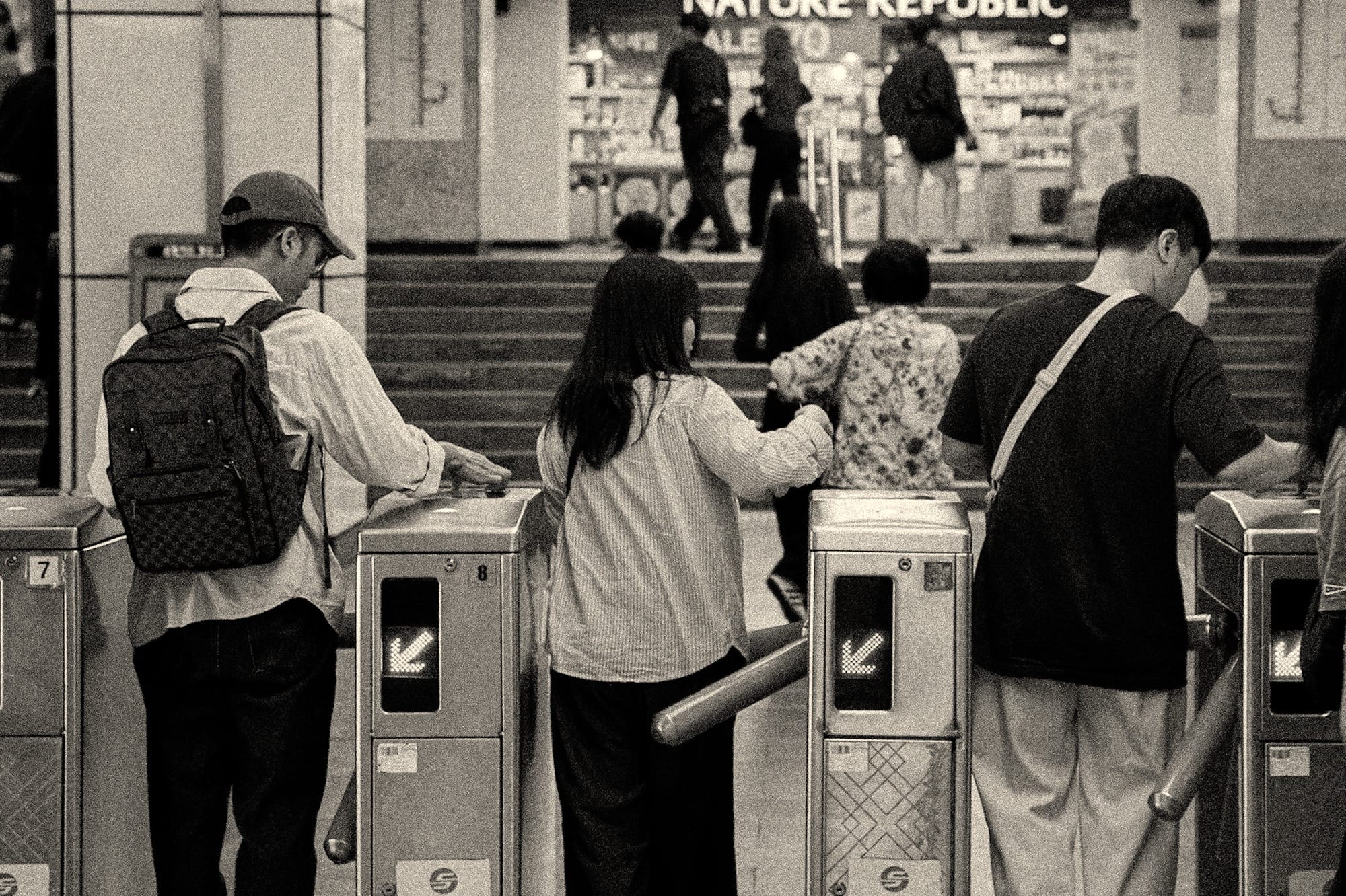
People move through the entry and exit turnstiles one at a time.
Read the tempo of the line.
Sense the person behind and avoid cutting them off.
Gauge whether to board now or wait for the next train when the doors open on a crowded car.
Inside the bus or subway car, the coordination grows more intimate.
You decide whether to offer your seat to someone frail or carrying an infant.
You shift your bag to make room for a stranger.
You negotiate shared space with bodies, elbows, voices, coughs and fatigue.
People help one another carry heavy suitcases up transit stairs.
They lift strollers when wheels catch on the metal lip of the escalator.
They stand aside for someone running urgently, even when it means missing the door closing behind them.
Transit is its own choreography. It is cooperative work performed in tight quarters, where attention, restraint, and generosity are essential.
Even when the vehicle itself is automated, the riders are not passive. They remain part of a social fabric that requires constant attention to others. They remain responsible for how well the shared space functions.
Transit preserves the cooperative muscle.
Autonomous driving risks letting it fade.
This distinction matters. Transit replaces the driver’s technical tasks, not the human-to-human ones.
In driving, automation erases the entire cooperative layer.
What Automation Removes
Autonomous driving promises safety, convenience, and efficiency. It will deliver those things.
But these gains create a vacuum that is not cognitive; it is cooperative. Automation subtracts the contexts in which we practice being cooperative humans.
Self-driving systems remove:
• awareness of others’ fragility
• shared responsibility for risk
• the need to anticipate real human error
• thousands of daily micro-adjustments
• tolerance-building moments
• spontaneous generosity
• distributed coordination
The danger is not that AI will make us stupid, a fear drawn too easily.
The real danger is that AI will remove one of the last environments where we practice social cognition at a high frequency.
Not thinking less. Coordinating less.
And coordination is what makes a society humane rather than merely functional.
When driving becomes something done around us instead of by us, we don’t just lose a skillset. We lose a training ground for mutual regard.
Mechanical safety may rise, but social safety may fall.
The Anti-Social Drift
When a society stops practicing cooperation, even in tiny doses, the consequences appear everywhere.
Empathy thins.
Patience collapses.
Tolerance weakens.
People become sharper-edged.
Small misunderstandings turn into conflicts.
Social grace evaporates.
Entitlement rises.
Individualism grows brittle.
You can already see signs of this.
Impatience in lines.
Escalation over small inconveniences.
A refusal to give the benefit of the doubt.
Irritation at having to yield or make allowance.
People reading malice where there is only error.
Zero slack in the system.
Zero generosity in the margins.
Driving has been a quiet corrective. A gentle reminder that you are not alone here. You share space with people whose lives matter as much as yours. You operate inside a structure where your choices affect strangers in a real and life-and-death way.
Remove the practice and the illusion of isolation returns.
“Everyone in their own bubble.”
“Everyone handles their own risk.”
“Everyone is responsible only for themselves.”
Machines can execute technical tasks flawlessly. They cannot teach humility, attunement, or patience. Those must be learned through friction, and driving is one of the only frictions we still share.
What the Wheel Taught Us
Autonomous driving is part of a larger pattern.
Modernization removes friction.
Removing friction removes practice.
Removing practice weakens capacity.
Weak capacity shapes weak character.
We become less of what makes us human by doing fewer human things.
You see versions everywhere:
• GPS erases navigation, and spatial intuition erodes
• Online shopping erases inconvenience, and patience thins
• Messaging apps erase discomfort, and confrontation skills collapse
• AI erases struggle, and attention frays
• Convenience erases hardship, and resilience drops
Driving is the next frontier. A domain where friction has meaning, where practice has consequence, where coordination is real, embodied, and urgent.
When modernization removes the friction of human presence, the need to watch and adjust and care, something in us weakens. Capacity is not built through ease. It grows through tension, risk, and adaptation.
The irony is that the more perfect our technologies become, the more imperfect our characters risk becoming, not through malice but through atrophy.
The Coming Loss No One Is Talking About
We dedicate endless debate to the risks of automation: job displacement, algorithmic error, liability, insurance, regulation. All valid. None fundamental.
The deeper loss is invisible to policy. It is the erosion of communal competence, the muscles that allow people to live among one another without fracturing.
That competence develops only through repetition of:
• shared risk
• unspoken protocols
• small generosity
• human unpredictability
• moment-by-moment decisions
• responsibility for others’ well-being
When we stop practicing this, we do not stay neutral. We degrade.
A society that stops practicing cooperation doesn’t become more efficient. It becomes more brittle. And brittleness breaks.
What Happens When the Wheel Turns Itself
Imagine the rituals that vanish when driving disappears.
Looking over your shoulder to make room.
Pausing so someone else can merge.
Feeling gratitude when a stranger waves you through.
Slowing because a mother and child approach the crosswalk.
Interpreting the hesitant inch of a new teen driver.
Reading urgency in another car’s acceleration.
Recognizing that your miscalculation matters because you are part of a shared world.
These small, uncelebrated moments shape who we are.
The road didn’t just teach us to drive. It taught us how to be with others while moving through uncertainty.
When machines take over, the road may no longer need us. We will still need what the road once demanded.
How to share risk.
How to sense others.
How to adjust.
How to give space.
How to remain human in motion.
The loss will be subtle at first, then pervasive, then structural: a decline in tolerance, a rise in entitlement, an erosion of grace, a shrinking of the social imagination.
The wheel turning itself is not the problem.
The human mind no longer turning outward is.
Closing
When the wheel turns itself, our minds won’t go quiet. We can replace the cognitive tasks. What we cannot replace is the cooperative muscle.
Driving was never just a task. It was a civic practice, a rehearsal for living among others.
The road won’t need us soon.
But we will need what the road once taught us.
If that practice disappears, something deeper than a skill is lost. A crucial part of our social intelligence goes with it.
And once that muscle weakens, rebuilding it will be far harder than teaching the machines to drive.
— Madonna Demir, author of Systems & Soul