
Games People Play | Inside the Informal Economy of the Enterprise
From casino games and missing windshields to hidden contracts and engineered failures of oversight, a collection of stories from decades of operational experience reveals the informal economy of the enterprise, the games people play, and what auditors should look for.


I. Hostage-Taking
Casino Hostage-Taking
Years ago, when Detroit casinos were brand new, my coffee klatch discussed them. Frankie came to us with an interesting report. He had spent the weekend throwing money around entertaining clients in the new venues, and he noticed a window of temporary opportunity.
“The casinos didn’t bring in power dealers from elsewhere, because nobody wants to come to Detroit, too cold in the winter and all, so they trained up dealers from scratch. Here’s the thing. They're all new and fumbly and if anyone at the table needs to make change for any reason (more chips, dealer add-on, etc.) play comes to a complete halt. I started adding it up in my head, how much the slowdown costs the place. It’s a lot. It adds up fast.”
Oh wow, we all responded.

“So here’s the opportunity,” Frankie continued, “I get an army of college students and some of my staff playing various games. They constantly invent the need to make change. The casino notices that the slowdown is costing them. I know people managing the venues. I go to them and offer to solve the problem – for big bucks, say 70 grand per casino. They agree. Then I simply tell my guys to stand down. Easy money.”
Did he do it? Not to my knowledge. He was a local businessman who needed clean connections in the city. But he wanted the social credit for recognizing the opportunity window, which he admitted was temporary in nature. Dealers would learn to be faster, and the venues would find more efficient cash handling mechanics.
You think that story would have nothing to do with large-scale enterprise, but it helped me to recognize this hostage-taking mechanism in an analogous situation.
The Dutchman Who Owned China
A large global company engaged a big consulting firm for an enterprise-scale transformation project. Four huge workstreams across the organization. With a good chunk of manufacturing operations in China, the cooperation of the Chinese operations was key.
But nothing moved them. Every workstream coming their way was stopped. Blocked. Didn’t move. Then an executive assigned there announced himself.
“I can get China to move. You just need to incentivize me with one of those payout agreements,” he said, referencing the executive incentive structure. Now, he did not qualify by role or by involvement. However, it was clear to us that he was holding progress hostage. The consulting firm would get him tossed, I suspected. They were one of the pushy firms who escalated quickly, in my experience.
Instead, they invented a hidden fifth workstream with its only goal as “the cooperation of China,” and with him named as the project executive, payout and all. His hostage-taking worked.
Now, I get it. The consulting firm just needed short-term cooperation, and they achieved that. But what about the second-order consequences? The long-term operational signals in the organization would persist long after their engagement closed.
II. The Parallel Enterprise
There are other forms of side gigs people attempt at enterprise expense. Some of them seem creative, others exploit a mechanism which wouldn’t occur to most of us.
Such as this one.
Reusable Packaging Pilot Failure
An automotive OEM ran a pilot on reusable packaging in Mexico and Brazil. On paper, it looked like a win-win-win-win.
- Win 1, Cost. TLC (total lifecycle cost) was projected to be much lower than with disposable packaging, once they solved for reverse logistics of the empty racks and dunnage.
- Win 2, Labor. Return logistics meant more trucking work for truck drivers.
- Win 3, Quality. Returnable racking and dunnage meant better quality control, because repeated use justified the investment in better protection. Thus the parts were even more protected in shipping than ever.
- Win 4, Ecology. The reusability of racks and dunnage meant better use of resources and less waste. Less plastic, cardboard and light wood to dispose of.
Seemed like the solution hit every note and would wildly succeed. It didn’t, at least in the first pilot. (They have since solved the problem.)
Can you guess why?
Too few racks and packs were returned. Folks couldn’t figure out why so many went missing. Were they engineered too flimsily, so some broke? Did staff need training on not disposing of them? Perhaps some were getting inadvertently thrown away? What could be the root cause? The OEM sent auditors to investigate.
It turned out that the racks and dunnage made great material for pop-up housing in informal settlements such as favelas. The solution for the next pilot was to downgrade the racking solutions to make them a bit less robust, only well-built enough to stand a handful of loads, in racks that were pieced together rather than large single-piece pillar-type strongholds for sheet metal parts.

Windshields, Windshields
The next case was a WIP (work in process) audit of a tier-one windshield encapsulation supplier on behalf of an automotive OEM. The team was asked to deep dive because the supplier was losing too many windshields to WIP errors during encapsulation.
In fact, eleven windshields had been damaged during WIP that very week. “Have the dumpster guys come to empty them yet?” I wondered aloud.
“No. The parts get dumped into the black bins for material recycling, but normal trash is in the green ones.”
We took flashlights out to the black bins. Empty. That was interesting.
The team set up cameras near the black bins. During the next shift, two windshields appeared on the damage report. We checked the footage. A worker was seen moving the windshields into a waiting truck bed, then tipping his hat to the driver. Off he went.
Someone followed the waiting truck the next night and the windshield replacement service vendor was identified. Footage was given to law enforcement and the supplier’s numbers got back on track.
Speaking of windshields, not far away was a different OEM’s luxury vehicle assembly plant, and a different supplier was having issues. Windshields were failing quality control (QC) checks after installation. Scratches deep enough to send them through a rework process for windshield replacement during assembly. The supplier was facing fines potentially in the millions, with its future business at risk. They first performed a 100% final inspection as parts left their facility. When that failed to solve the problem, they installed a top QC inspector of their own on the assembly inventory floor, looking at each part before it went to the line. And yet. The problem persisted.
I’ll skip the details, but the problem was found to be a long-term assembly employee with considerable standing on the factory floor. He wore a thick gold bracelet and by policy, bracelets were to be covered with a soft wrap during assembly, or removed. He was found to be in cahoots with a different windshield replacement service and taking orders for the high-cost luxury windshields; fulfillment meant scratching specific ones during assembly with his bracelet. The windshield replacement service simply repaired the perimeter scratch on installation.

So what do the windshield stories have in common? A secondary market demand which created a side hustle related to damaged part value recapture. In one case, existing rejects were diverted. In the other, rejects were being created to satisfy demand. Let’s cover another example.
Medical Cartridges
In this case, a leader in a medical device manufacturing organization was running a value capture campaign in a specific medical equipment unit of the operation. They were looking at opportunities for cost savings, cost avoidance, and revenue upside potential.
One type of equipment came loaded in a payload cartridge for transport and quality protection. These were stickered for branding, but other manufacturers used identical payload vehicles. Think of them like bullet casings, pretty generic.
The project facilitator identified a potential source of value recapture. We were supposedly throwing these away, though there were secondary market folks who reused the cartridges for reload and resale. Why not have our facility sell to the reload supplier? Easy money, my guy on the floor said. However, he was shut down at every turn, by the warehouse and staging supervisor and even the plant manager.
He connected with a colleague higher up in the organization. “Drop it,” the big boss advised. He told the campaign facilitator that the reload supplier was reportedly already using our cartridges, with staff capturing the value for their own personal benefit. He feared sabotage of other parts of the operation if the opportunity were threatened. The value was comparatively small and, in his assessment, the downside risk for larger medical devices in the factory was real.
Audit tip: When a secondary market exists, look for evidence of diversion. For damage claims and discarded materials, audit cradle to grave, including a visit to the “grave site” of the disposed part.
Drugs, Gold and Chain-of-Custody Risk
One institution I know of had controlled substances disappear during the handoff between supply chain and research. Although deliveries were recorded, the receiving organization had not yet taken custody when the losses occurred. Detectives would be called, reports made. But the checks associated with research custody had not yet come into play.
To close the gap, departments such as supply chain and police and public safety officers worked together to create a seamless, independently verifiable chain of custody.
Closing the gap, though, drew the ire of a handler, who asked that things be “put back to normal” and raged upon learning that doing so would require multiple departmental sign-off. The reaction raised questions about who benefited from the old arrangement. Whatever those incentives may have been, the vulnerability itself was real and the redesigned chain of custody addressed it.
For more on institutional handlers, see my essay The Handler.

In another situation, a medical device OEM made micro-devices which used a lot of thin gold wire. Gold was useful because of its hypoallergenic properties and suitability for fine welding under a microscope. However, their gold cost was through the roof. An audit ascertained that they were using three times as much gold as their production should require. Simple excess possibilities, such as inaccurate measurement of the wire by a millimeter or so, would not explain it. Gold has a wide secondary market. Rather than pin down details of who or where, the chain of custody was reinforced by several new redundant mechanisms. Gold costs returned to predicted levels.
III. The Governance Games
So now we move from control mechanisms of actual parts and materials to the information economy.
Travel, Perks and Hidden Pay
In one public institution, a top executive was said to have kept a paper contract in a desk drawer. This contract covered a revenue-sharing agreement between a large organization and the institution itself. The institution frequently received requests for documents under FOIA. But a search of the contract management system would not have surfaced this agreement. The executive had no direct FOIA responsibilities, as queries were managed elsewhere in the organization.
The contract reportedly contained clauses providing for personal travel for that executive, paid for by the supplier partner, plus a generous expense budget. A subordinate who feared retaliation surfaced the document, and it was referred to internal audit. Whether the executive actually availed himself of the contractual benefits is unknown.
The leverage here was not hiding product but hiding documents outside of the mechanized system of contract management. Hand-signed and mere paper, stuffed in a drawer.
Whisper Contract
Another contract whispered about at an institution concerned solar panels. Questions circulated internally about the economics of the arrangement, including the use of institution-owned land, capital contributions with upfront charges said to be many times the cost of installation, recurring fees and expensive electricity purchase commitments. But again, no contract could be found in the contract management system of record. Without the agreement itself, the economics could not be independently assessed.
This is precisely the kind of agreement I would want an auditor to obtain and evaluate. Who funded the capital investment? Who owned the assets? Who bore the risk, and who captured the value over the full term of the agreement? How did the economics compare with direct ownership or alternative sources of power?
Vote Now, Read Later
As I was writing this, I watched a recording of a city council meeting where a councilwoman asked to read a contract before voting yea or nay. She was told she was slowing things down and that to get the contract, she would have to FOIA it like any citizen. She asked to delay voting until she had done so. Denied. She was the only nay vote, according to the meeting I saw online.
What do all of these cases have in common? Contracts hidden from view, whether outside the normal systems of record or withheld from the very people being asked to approve them. In the last case, a push for action before viewing could occur.
And then there is the over-under play.
Over-Under Play
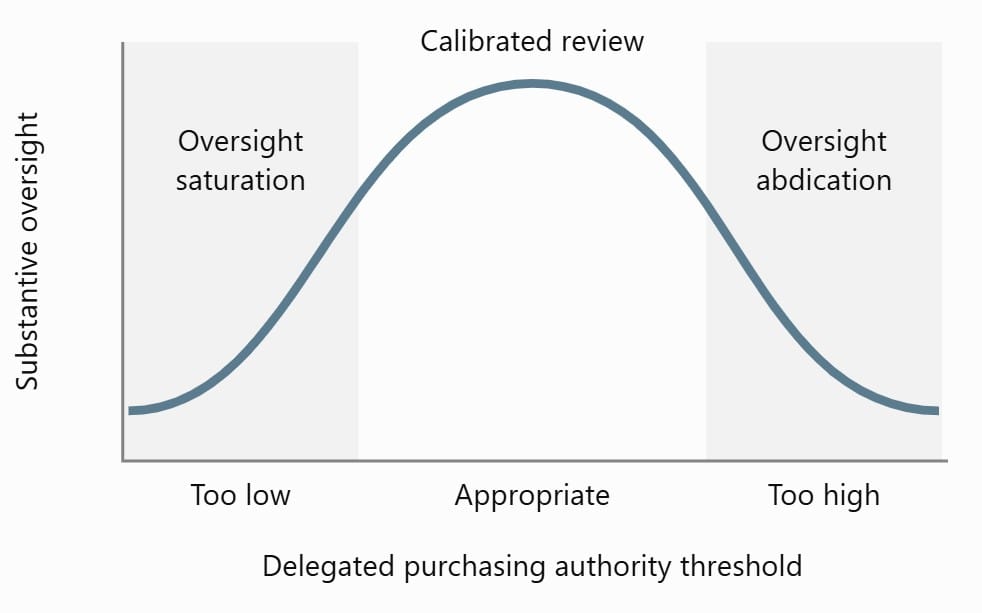
In one institution, the top procurement executive had to review and sign a tremendous number of contracts personally. He had a large staff, but the purchase threshold for his signature was set so low that nearly every one required his review and signature by policy.
He confessed this meant he could only audit them, which meant to review select ones. The volume overwhelmed him, making it much easier to hide needles in the haystack (by needles, I mean all of the things which point to corruption).
On the other side of things, another institution had the opposite. The top procurement executive gave the deputy such a high-dollar threshold that the executive never needed to sign anything. Whatever the intent, the arrangement afforded the executive plausible deniability by design.
There is an appropriate level for review, and these plays leveraged the over-under tails. Too low a threshold and you saturate the reviewer. Too high a threshold and you remove executive review from the process altogether.
IV. What Conventional Audits Miss
So let’s break down what we have covered. In each of these cases, there was something an auditor could look for. Sometimes it was evidence that existed but had not been examined. Sometimes it was evidence that should have existed and didn’t. And sometimes the design of the control itself was the clue.
Hostage-taking
Diagnostic signal: Unexplained obstruction; compensation for restoring cooperation.
Audit focus: Trace the origin of incentive agreements. Who benefits from the problem and its resolution?
Packaging and secondary markets
Diagnostic signal: Unexplained attrition of returnable assets.
Audit focus: Examine alternative uses, residual value and actual return rates.
Scrap and manufactured defects
Diagnostic signal: Missing evidence of disposal; defects after verified quality checks.
Audit focus: Reconcile physical disposition to records; isolate where defects originate.
Resistance to value recovery
Diagnostic signal: Repeated blocks to an economically attractive initiative.
Audit focus: Examine who already benefits from the existing arrangement.
Chain of custody and material use
Diagnostic signal: Losses at handoffs; consumption exceeding engineering requirements.
Audit focus: Reconcile custody end to end and actual usage to expected consumption.
Hidden agreements
Diagnostic signal: Commercial relationships without accessible executed contracts.
Audit focus: Build an independent inventory using financial flows and counterparty records.
Contractual economics
Diagnostic signal: Commitments whose value or risk allocation is unclear.
Audit focus: Test whole-life economics, alternatives, ownership and conflicts of interest.
Governance and delegated authority
Diagnostic signal: Approvals without access, time or meaningful review.
Audit focus: Test information access, reviewer capacity, approval thresholds and retained accountability.
Subjecting Public Agreements to Public Scrutiny
In a public institution, I would start with the 50 largest commercial agreements, including revenue-sharing agreements, public-private partnerships (P3s), licensing and other arrangements that may never pass through procurement. I would establish the population independently of the contract repository, obtain the executed agreements and amendments, and subject their economics and governance to public scrutiny, consistent with applicable disclosure requirements.
The point is to establish the audit universe by economic materiality, not only by the administrative metadata labels attached to deals. A purchase contract, a revenue-sharing agreement and a P3 may be filed in entirely different places, yet each can commit substantial institutional resources.
There is a difference between evidence of approval and evidence of oversight. A signature tells us who signed. A recorded vote tells us how the members voted. Neither tells us whether the person had the information, time or capacity to exercise judgment, nor who designed layers of plausible deniability to avoid accountability.
These are practical extensions to my Audit Guide: Detecting the Handled Institution. The guide examines how institutional processes can be handled, and how an auditor might detect that handling.
The games people play are often visible at the edges of the formal enterprise: in what leaves the factory, what never enters the system of record, what cannot be reviewed, and what people are paid to make go away. Those edges deserve as much attention as the transactions we already know how to audit.
Author’s note: These accounts draw on professional experiences accumulated over several decades, including firsthand observations and accounts shared by others. Names, identifying characteristics and certain operational details have been changed or omitted to protect the identities of those involved. Conversations are reconstructed from memory. The accounts are illustrative and are not intended as findings of legal liability or individual culpability. The focus is on the mechanisms at play and their implications for institutional design, governance and operational auditing.