The Meeting Before the Meeting
Ever seen a baseball get someone promoted in a technical role? I have.


Alex Enters the Meeting
Alex walked into the already full conference room and closed the door behind him. Jeff, VP of Operations, sat at the head of the table. The room got silent as Alex settled in, laid his laptop on the table and pushed his chair back slightly to accommodate his spread-out legs. Alex had played college basketball and his body placement ensured that his lanky figure always achieved maximum surface area by any 2-dimensional cut.
Jeff cleared his throat, a signal the meeting was about to begin. Alex interjected, “But first. A dick-swinging contest. Always start there.” Well, to be honest, Alex didn’t say that out loud. Instead he said, “How bout those Knicks, eh? That shot in the third quarter? Three point swish!” and he emphasized the swish sound while mimicking the play with his wrist flip.
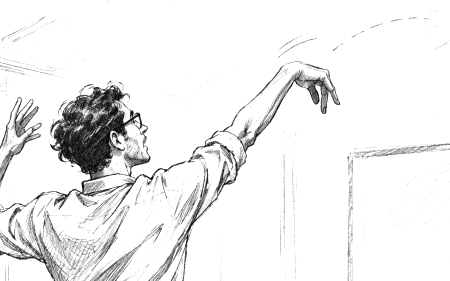
Banter about the weekend basketball games continued for seven or eight minutes. Satisfied with his win in the dicks-on-the-table exercise, Alex now signaled to Jeff that the meeting could begin.
I have zero or less than zero interest in team sports. I like botany, birds and yoga.

However, Alex’s discussion of his hobbies signaled social belonging, camaraderie and leadership potential while mine would have signaled “ewwww, loner.” The asymmetry was vivid. Bringing up my personal interests would have gotten me negative social credit. But Alex’s got him points, even though it was clear almost no one in the room shared his passion for basketball.
It's All (or Most) of Them
I lived some version of this in nearly every workplace. And I saw the Alexes of the world get promoted. Time and again. Without doing the work, or while doing it poorly.
Some women tried to fully participate. Studied sports scores, watched games, made sure they knew all of the weekend highlight reels by heart. It didn’t work. Landed flat. Their take on the game would be disputed, dismissed or talked over. It was not their role to play, clearly.
When they demonstrated sports knowledge, the standard moved.
Suddenly it wasn't enough to know the game. They had to survive challenges to their credibility, increasingly obscure statistics, louder voices, and condescending corrections, a classic double (in this case triple) bind:
- Don't participate, and you're outside the social circle.
- Participate with insufficient knowledge, and you're dismissed.
- Demonstrate equal knowledge, and your competence is challenged anyway.
Sports knowledge wasn't actually the criterion for belonging. It was merely a mechanism for establishing and defending status – whose is bigger.
Asymmetries Reinforce one Another
And observe how the resulting three asymmetries reinforce one another.
Sports over botany: One set of interests is treated as legitimate social currency. Other intellectual interests aren't afforded the same conversational space or respect, and are even seen negatively.
Men over women: The dominant social currency is drawn from a traditionally male-centered culture. Men fluent in that culture enjoy a built-in advantage in access, familiarity, and informal sponsorship. Women are expected to accommodate, not participate in it.
Impression management over real work: Visibility, relationships, and perceived cultural fit become substitutes for demonstrated contribution. The people who master social cues can advance without delivering any corresponding work value.
Rick and His Baseball
In one workplace, we had an analyst named Rick. He had been a college baseball star. He kept his trophies on his desk. And a player’s mitt. His favorite baseball was pulled from a drawer each morning, and then Rick took off to make the rounds.
He tossed the baseball into the air and caught it, repeatedly, while talking sports scores and happenings to various guys in the office all day long. In the year and a half I worked on Rick’s floor, I never saw any output from him, never observed him doing any actual work at all – a classic personality hire.
Then, predictably, Rick was promoted.
Sports Is Big Business. Media Follows. But Workplaces Don't Have To.
Now, I completely understand that sports is big business. Games often make front page news. Media follows mainstream interests and ad dollars, that tracks.
However, workplaces presumably get to choose what they reward.
In both Alex and Rick’s cases, employers had an opportunity to see through the theater. Jeff controlled the room but allowed Alex’s contest to dominate the start of every meeting. Rick was an analyst whose working day, as far as I could observe, was organized around a baseball tossing ritual. He could have been judged on his actual output and promoted only when his work merited it.
Real work is measurable. So is its absence. Yet supposed social ease often gets translated into leadership potential, and eventually into promotions.
The cost to organizations isn't just seven or eight minutes of basketball talk. It is the signal sent to everyone watching. Thou shalt learn the dominant group's rituals. Accommodate them. Understand that your actual contribution might matter less than your ability to perform belonging in the narrow way we have defined it.
And for women, remember, even learning the rituals doesn’t guarantee entry. The gatekeepers simply move the gates if you even try to signal belonging in the org’s language.
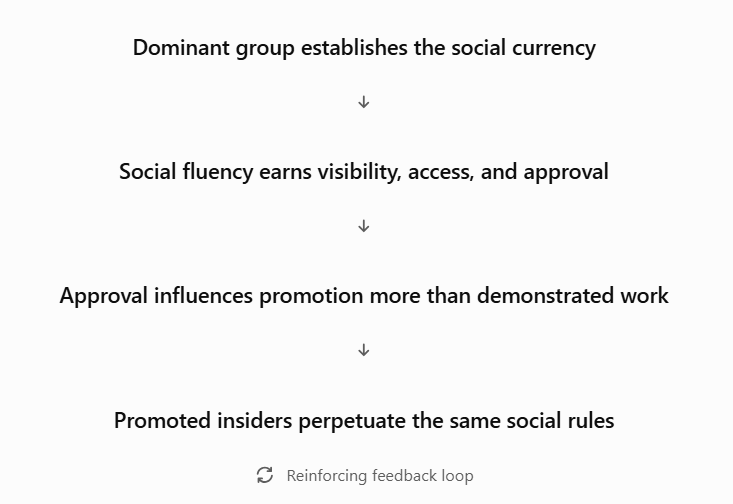
Then the system feeds itself. Social familiarity becomes access. Access becomes sponsorship. Sponsorship becomes promotion. And the newly promoted perpetuate the same criteria, rewarding people who remind them of themselves, or the younger imagined selves they wish they still were.
Meanwhile, somebody else in the organization is actually doing the work, answering the questions, documenting the commitments, and solving the problems every day.
I don't care if you love basketball. Please, love basketball. I love trees. But if your hobbies confer professional credibility while mine diminish it, our organizational reward system has a problem. And if your mastery of a ridiculous time-wasting social ritual earns you promotions that your actual work doesn't justify, we have a much bigger one.
Because when the least productive person in the room becomes the most rewarded, the problem is no longer just the man swinging his dick.
It's the organization handing him the trophy.
 Madonna Demir

Read more on inverted organizational reward systems here